

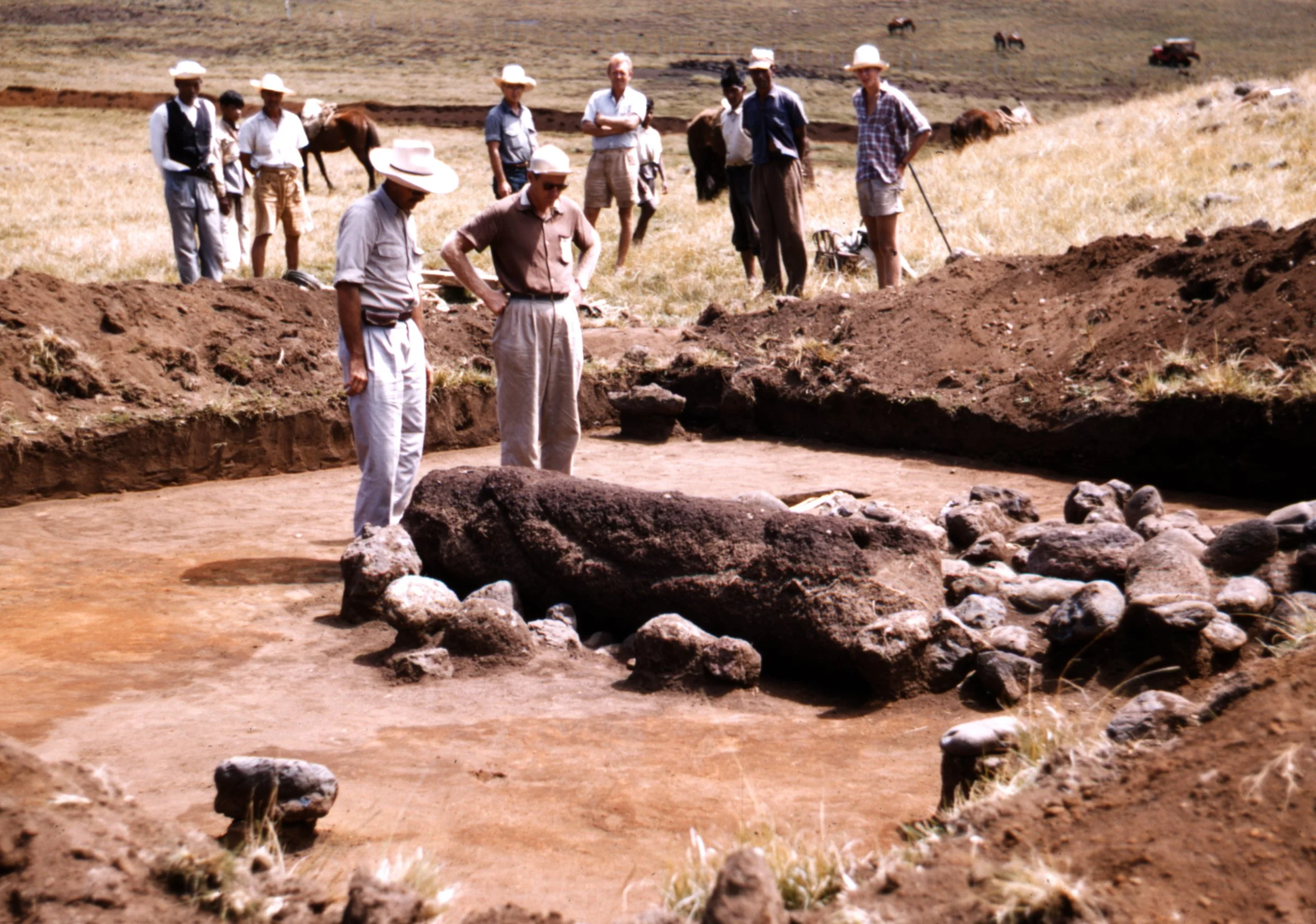
Archaeologist Carlyle S. Smith and Thor Heyerdahl looking at a newly discovered statue at ahu Vinapu. This was the first major excavation of an ahu or marae on Rapa Nui, and a key site in discussing the origin of the Polynesian temple complex.
New research challenges the long-held belief that Rapa Nui (Easter Island) developed in isolation after a single wave of settlers. Instead, evidence points to multiple settlement events and sustained cultural exchange across East Polynesia.
From CE 1000–1300, early settlers created simple ritual sites tied to burial and communal feasting, showing deep ideological continuity with other Polynesian cultures. Between CE 1300–1600, more formal ritual architecture, marae and ahu temple platforms, originated on Rapa Nui and then spread westward, reversing the expected cultural flow. By CE 1350–1800, growing social hierarchy across islands like Rapa Nui, Tahiti, and Hawaiʻi fueled the rise of massive stone monuments, including Rapa Nui’s iconic moais.
The shared presence of ahu/marae throughout Polynesia supports a dynamic, multi directional ritual tradition carried by skilled seafaring networks that exchanged people, ideas, and monumental styles across vast distances. Rather than an isolated outlier, Rapa Nui emerges as a major cultural innovator whose influence radiated across East Polynesia.
Thor Heyerdahl led the famous 1955-56 Norwegian Archaeological Expedition to Rapa Nui and the East Pacific, undertaking the first professional archaeological excavations on the island. The expedition investigated the moai-statue quarry in Rano Raraku, excavated the ceremonial site of Orongo and at ahu Vinapu.
Thor Heyerdahl also asked the islanders to show him how they carved and erected the famous moai-statues, which they did in now famous experiments. His popular book about the expedition Aku-Aku. The Mystery of Easter Island (1957) brought the mysteries of Rapa Nui to the readers and visitors to the island.
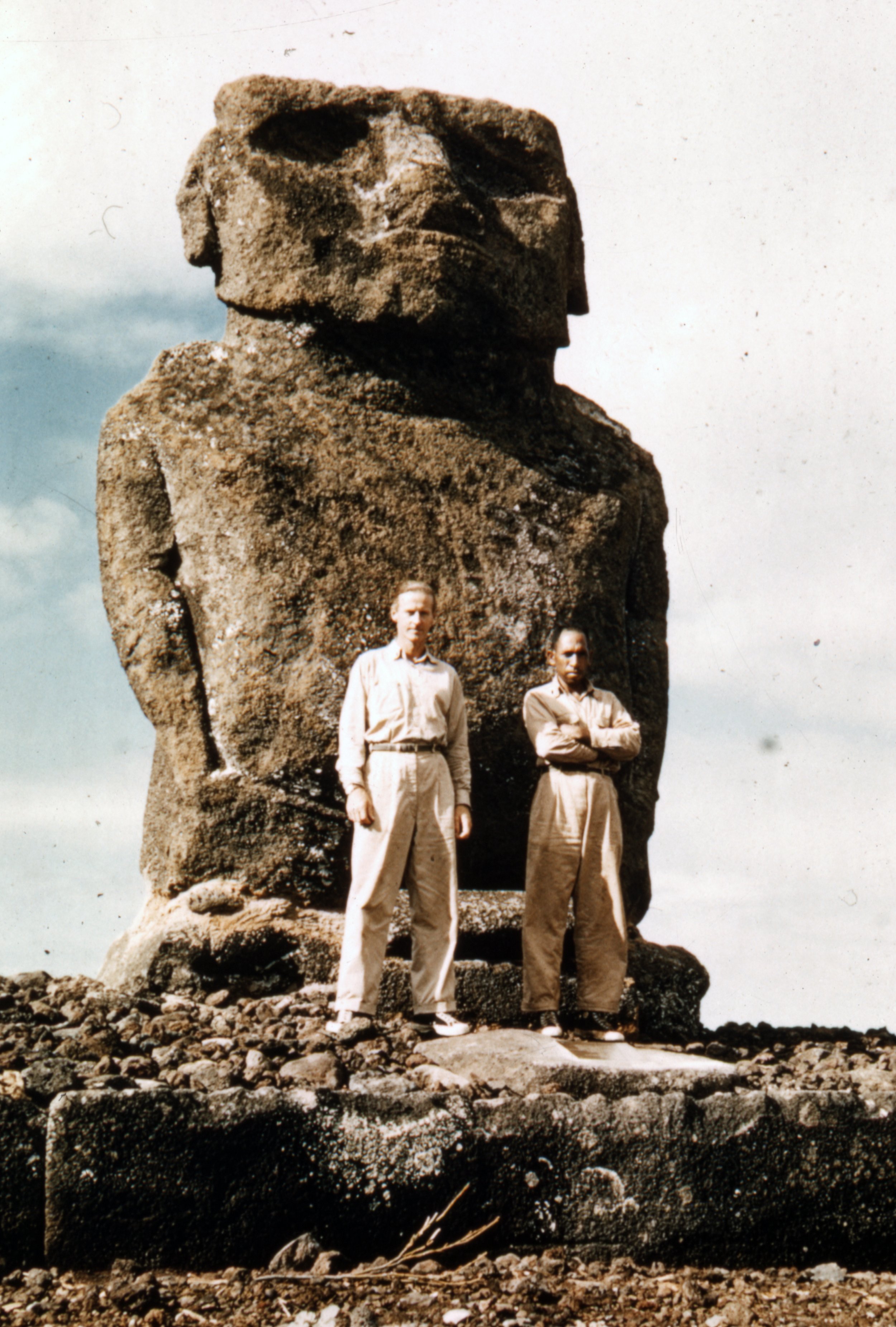
Thor Heyerdahl and Lazaros Hotu after the finishing the job in Anakena, in February 1956. Lazaros Hotu had been part of the Rapanui team that demonstrated how the indigenous people of the island erected large stone statues onto megalithic tempel platforms, locally called ahu or marae in the Society Islands.