

How Kon-Tiki launched a worldwide age of experimental seafaring
When Kon-Tiki struck the reef at Raroia on August 7, 1947, one voyage ended—and an entire fleet was launched.
Thor Heyerdahl and his five companions had traveled more than 4,000 miles from Peru in 101 days aboard nine enormous balsa logs lashed together with rope. The expedition had been conceived as a practical test: could a vessel based on Indigenous South American technology survive a voyage from the American continent to Polynesia?
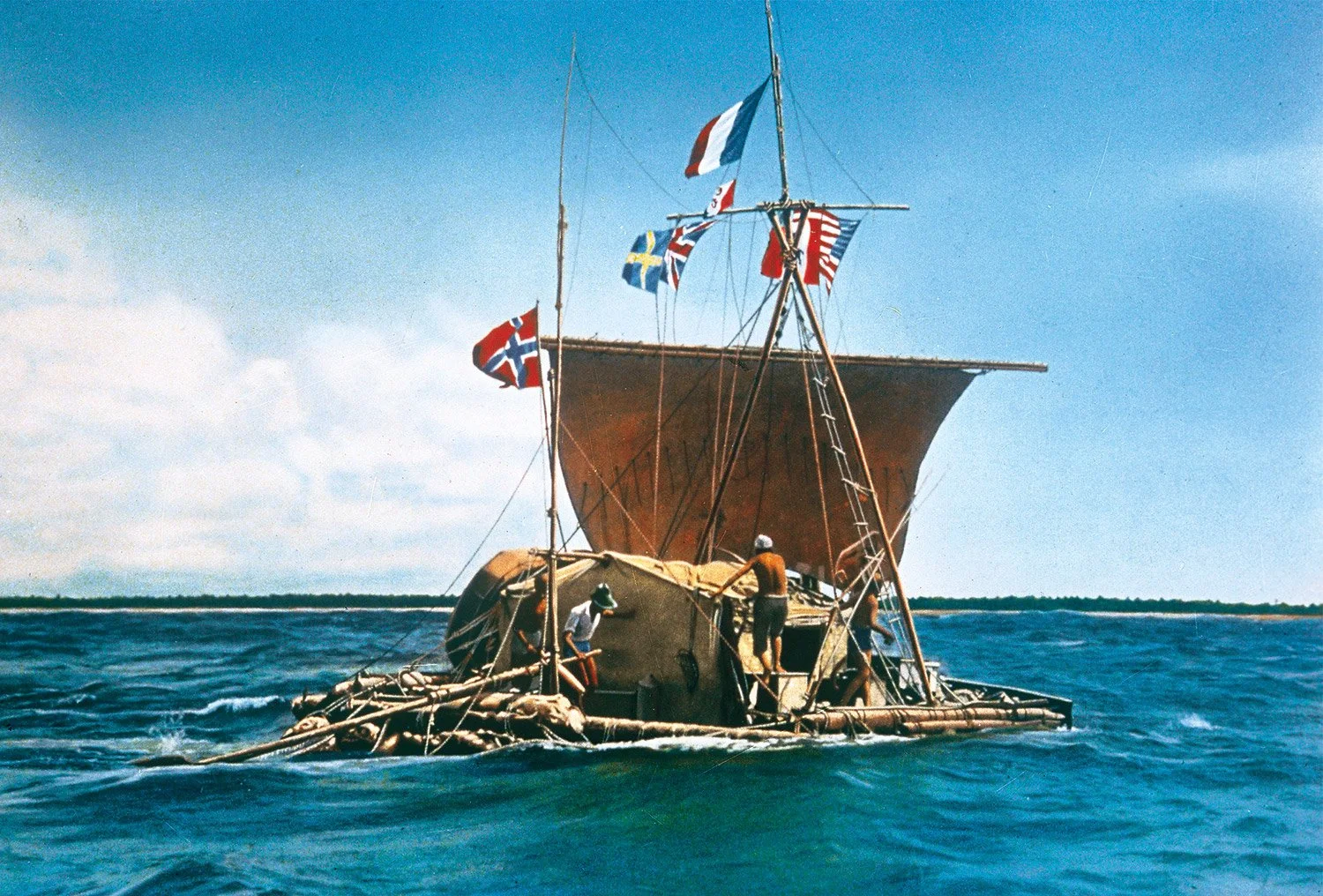
The answer was yes.
That result did not prove Heyerdahl’s much larger theory that people from South America had played a decisive role in settling the Polynesian islands. A successful modern crossing could demonstrate possibility, not establish a prehistoric event. Yet the voyage changed the way questions about ancient navigation could be investigated. Instead of debating only in lecture halls or academic journals, an explorer could build a vessel, place it in the real ocean, and let wind, current, materials, and human endurance become part of the argument.
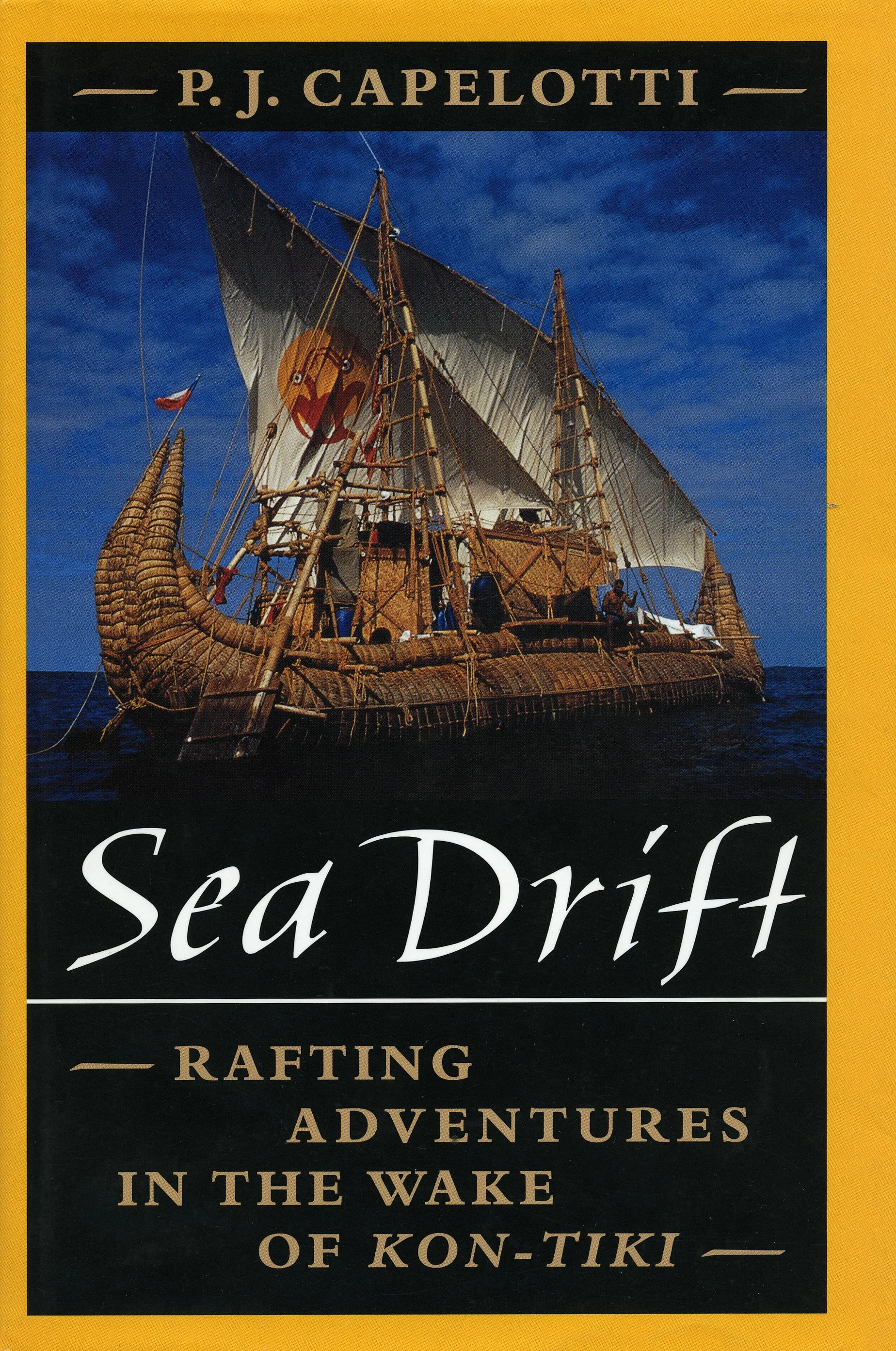
The American researcher and writer P. J. Capelotti describes in his book Sea Drift (2001) Kon-Tiki as both an extraordinary sea adventure and one of archaeology’s most original experiments. Once the raft reached Polynesia, he argues, the oceans became “archaeological seas”—places where researchers and adventurers could explore not only the present but also possible journeys made in the remote past. This text is based upon the book.
The voyage had created a new kind of explorer.
And over the following decades, they began putting to sea.
A New Kind of Experiment
The formula appeared deceptively simple.
Begin with a question. Build an unconventional vessel that might help answer it. Find the right wind or current. Then leave shore and accept that the experiment could fail spectacularly.
Later expeditions borrowed different parts of Heyerdahl’s example. Some reproduced ancient-looking rafts and boats. Others used rubber, plywood, metal drums, or bamboo. Some investigated prehistoric migration and trade; others were concerned with survival, psychology, religion, or simple personal endurance.
Many admired Heyerdahl. A few set out to challenge him. Yet even those who disagreed with his conclusions tended to accept his central method: a voyage could become a physical test of a historical or scientific idea.
Capelotti saw the expeditions after Kon-Tiki as a slow race across the oceans and into the past. Their crews employed currents and winds to investigate how cultures might have come into contact—or how human beings might endure such crossings. They also compared their speed, distance, and performance with Heyerdahl’s famous raft.
The results ranged from valuable experiments to eccentric spectacles. But together, the voyages created a new tradition of experimental seafaring.
Survival and Solitude
The first expedition to follow Heyerdahl’s example did not attempt to reconstruct an ancient migration. It asked whether a modern castaway could remain alive at sea.
In 1952, the French doctor Alain Bombard crossed the Atlantic aboard the inflatable raft L’Hérétique. He had studied why survivors of shipwrecks often died quickly, even when the human body should have been able to survive much longer. Bombard believed despair was one of the greatest dangers. He also argued that a person adrift could obtain water from fish and, under controlled circumstances, consume small amounts of seawater.
Like Heyerdahl, Bombard understood that laboratory research alone would not persuade skeptics. He transformed himself into the subject of the experiment, using the Atlantic as his laboratory. His craft was modern, but the method was unmistakably post-Kon-Tiki: take a disputed proposition out of the archive and expose it to the ocean.
Two years later, an American sailor named William Willis left Peru alone on a balsa raft called Seven Little Sisters. Willis was sixty-one. He was not attempting an exact reconstruction of a pre-Inca vessel, nor was he chiefly interested in proving a theory about migration. He wanted to discover how far he could push his body and mind.
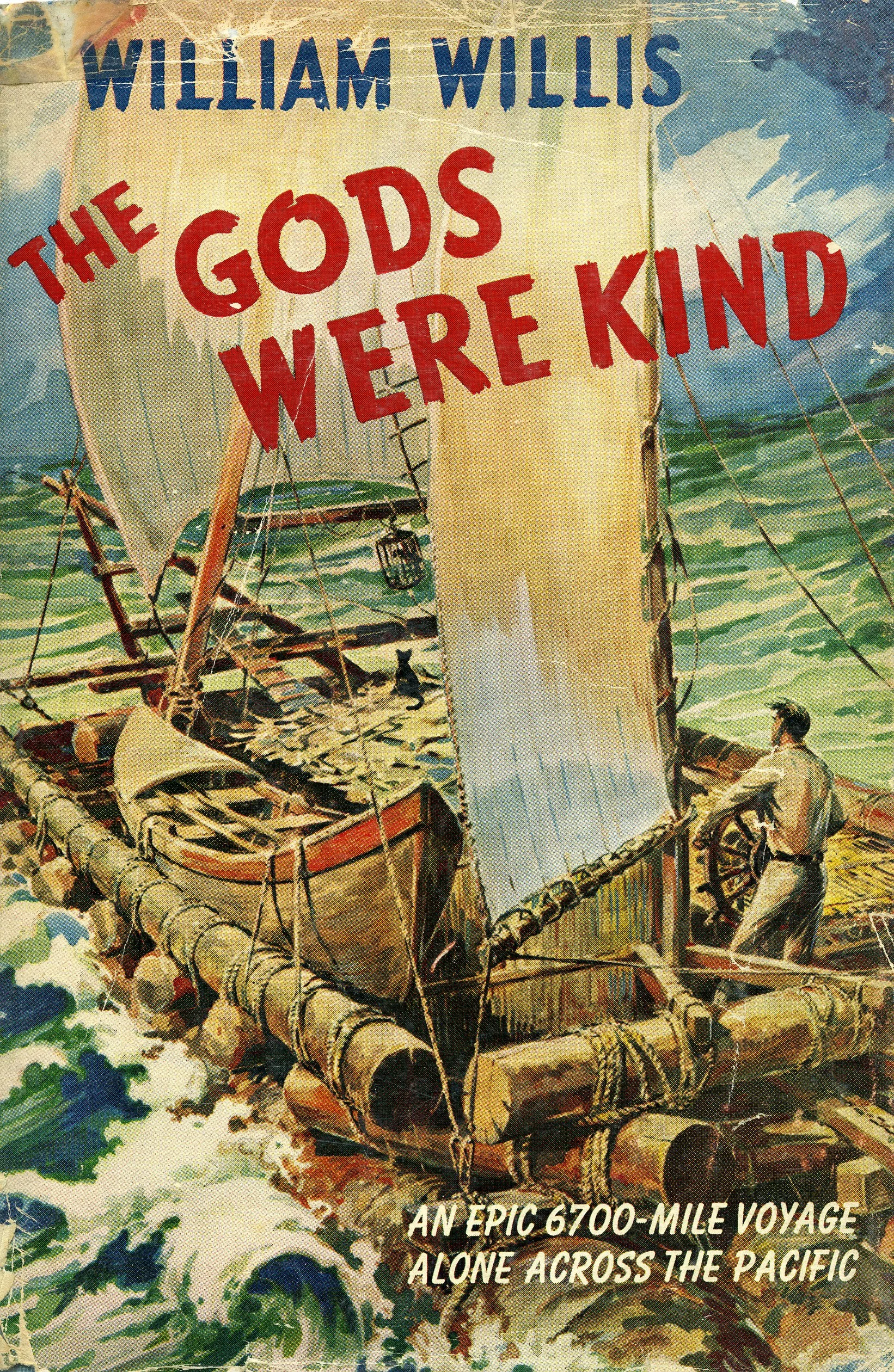
Photo: Faximilie of William Willis’ book The Gods Were Kind, 1955.
For 115 days, accompanied by a cat and a parrot, Willis drifted across the Pacific to American Samoa. The voyage became a meditation on solitude as much as a feat of seamanship. In 1963, now in his seventies, he departed again aboard Age Unlimited. He reached Samoa and continued the following year to Australia, completing roughly 9,800 miles in about 200 days. During the crossing, an accident injured his spine, forcing him to improvise a traction device and remain flat on his back for several days.
Willis’s experiment was the aging human being rather than the raft. Yet without Kon-Tiki, it is difficult to imagine the voyage taking the form it did. Heyerdahl had shown that a deliberate ocean drift could command public attention and turn endurance into evidence.
The Frenchman Henri Beaudout carried the model into the North Atlantic. His first cedar raft, L’Égaré, drifted down the St. Lawrence system before wrecking on Newfoundland in 1955. He tried again the following year. L’Égaré II entered the Gulf Stream and crossed from North America toward Europe, eventually reaching Falmouth after a voyage of nearly 2,500 miles.
The raft was no longer solely a reconstructed artifact. It had become a platform on which people tested hunger, fear, loneliness, buoyancy—and themselves.
Following—and Challenging—Kon-Tiki
Other explorers returned directly to Heyerdahl’s Pacific question.
The most formidable early challenger was the French navigator Éric de Bisschop. Where Kon-Tiki had traveled from east to west, de Bisschop wanted to show that a primitive raft could make the far more difficult voyage in the opposite direction—from Polynesia toward South America.
His bamboo raft Tahiti-Nui I left Tahiti in 1956. To find winds blowing toward the American continent, de Bisschop sailed far south into rough latitudes. The raft was battered for months and began breaking apart several hundred miles from the Chilean coast. The crew had to be rescued.
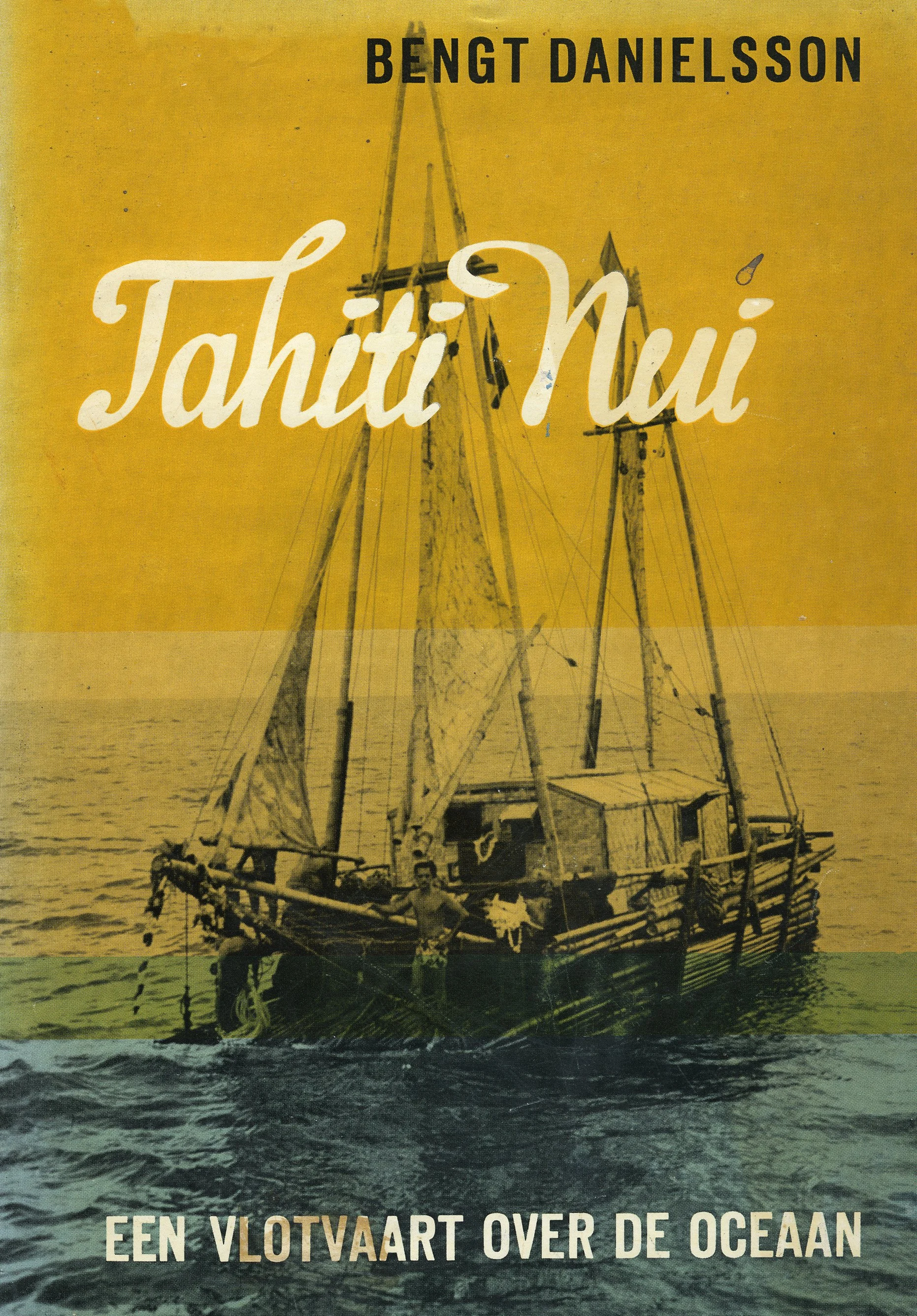
Photo: Faximilie of Bengt Danielsson’s book on Eric de Bishop’s voyage with Tahiti Nui, Dutch Edition.
Failure did not end the experiment. De Bisschop built Tahiti-Nui II in Chile and set out westward in 1958. The crew carried a copy of Heyerdahl’s book and compared their daily progress with Kon-Tiki, almost as though the two rafts were competing in a race eleven years apart.
But Tahiti-Nui II was difficult to control and steadily lost buoyancy. After passing the latitude where the crew expected to turn toward Tahiti, the raft continued stubbornly west. Water eventually covered the deck and flooded the cabin. A smaller emergency raft, Tahiti-Nui III, was constructed at sea, but it was destroyed on the reef at Rakahanga. De Bisschop was killed.
The tragedy did not invalidate the voyage’s evidence. The rafts had traveled enormous distances. They had also exposed the difference between demonstrating that a vessel could drift across an ocean and showing that it could reach a precise destination.
Others continued the east-to-west route. Eduardo Ingris’s first La Cantuta became trapped for months in the Equatorial Countercurrent near the Galápagos. His second raft, La Cantuta II, successfully reached central Polynesia in 1959.
The Spanish explorer Vital Alsar was inspired by reading Kon-Tiki as a young man. His first major attempt, Pacifica, left Ecuador in 1966 but became caught in the same unpredictable countercurrent. After 143 days, the crew was rescued only hours before the raft disappeared beneath the sea.
Alsar tried again.
In 1970, his balsa raft La Balsa crossed the entire Pacific from Ecuador to Australia—a voyage more than twice as long as Kon-Tiki’s. In 1973, he repeated the achievement with a fleet of three rafts: La Aztlán, La Guayaquil, and La Mooloolaba. The three vessels reached Australia after 179 days.
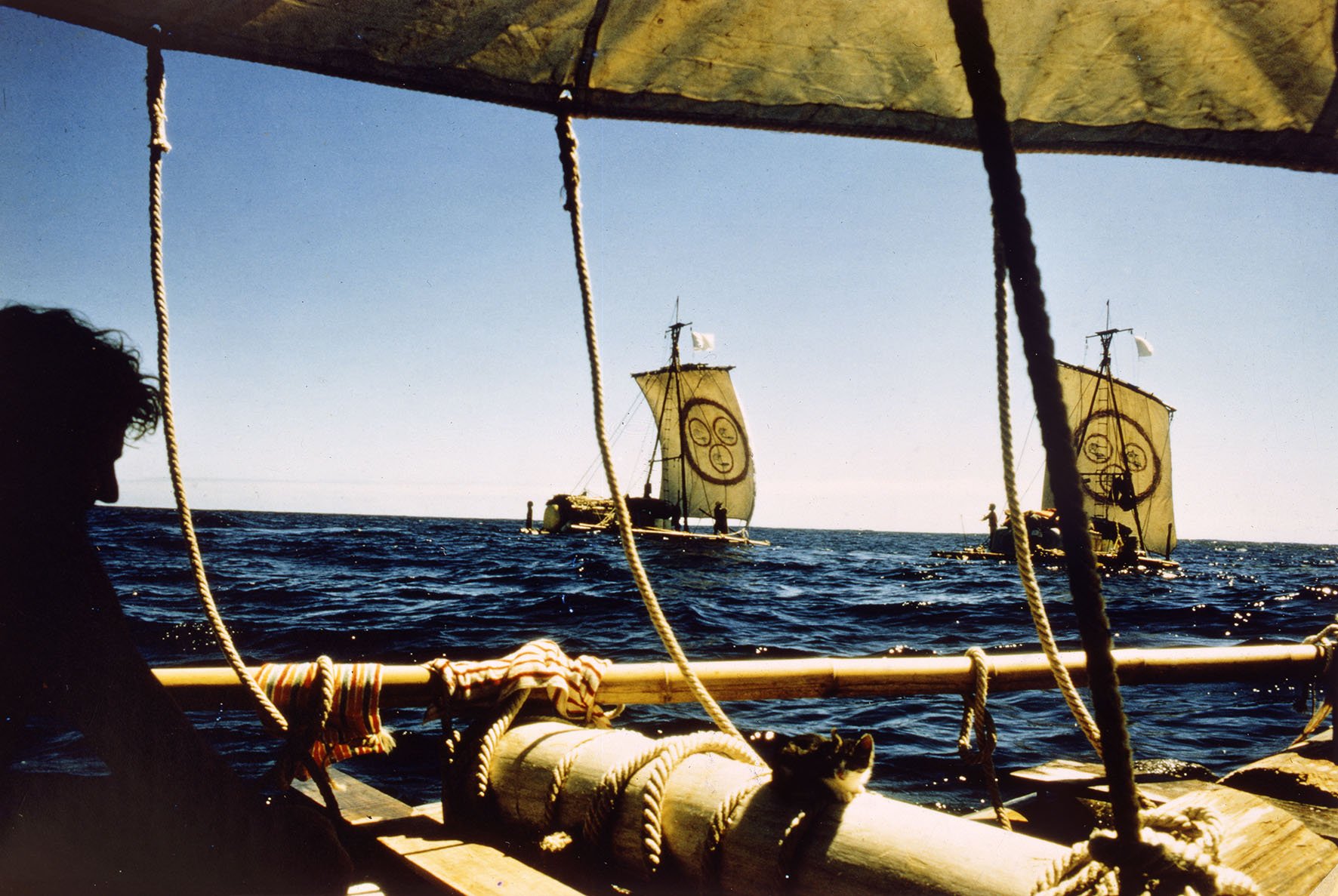
Photo: Vital Alsar on his expedition in 1973 with La Aztlán, La Guayaquil, and La Mooloolaba (Photo: The Kon-Tiki Museum Archive).
By then, the question of basic capability had largely been answered. Capelotti notes that more than a dozen rafts departed from South America for the Pacific islands between 1947 and 1973. The voyages demonstrated repeatedly that South American-style rafts could carry people and supplies over immense distances.
They still could not prove who had traveled in prehistory. But the raft itself could no longer be dismissed as an incapable bundle of logs.
Beyond Balsa
Heyerdahl did not remain with the Pacific experiment that had made him famous.
During the 1960s, his attention shifted to the reed boats depicted in ancient art and still constructed by traditional boatbuilders in Africa and South America. If balsa rafts could cross the Pacific, could vessels made essentially from grass cross the Atlantic?
The first papyrus ship, Ra, left Morocco in 1969. Its international crew discovered quickly that a reed boat was not simply a softer version of Kon-Tiki. It demanded constant work. Steering oars broke, the stern sagged, and seawater gradually penetrated the structure. After traveling thousands of miles and coming close to Barbados, the crew abandoned the vessel.
The failure proved instructive.
For Ra II, Heyerdahl turned to Aymara builders from Lake Titicaca, whose understanding of bundled-reed construction helped correct weaknesses in the first ship. In 1970, Ra II crossed successfully from Morocco to Barbados.
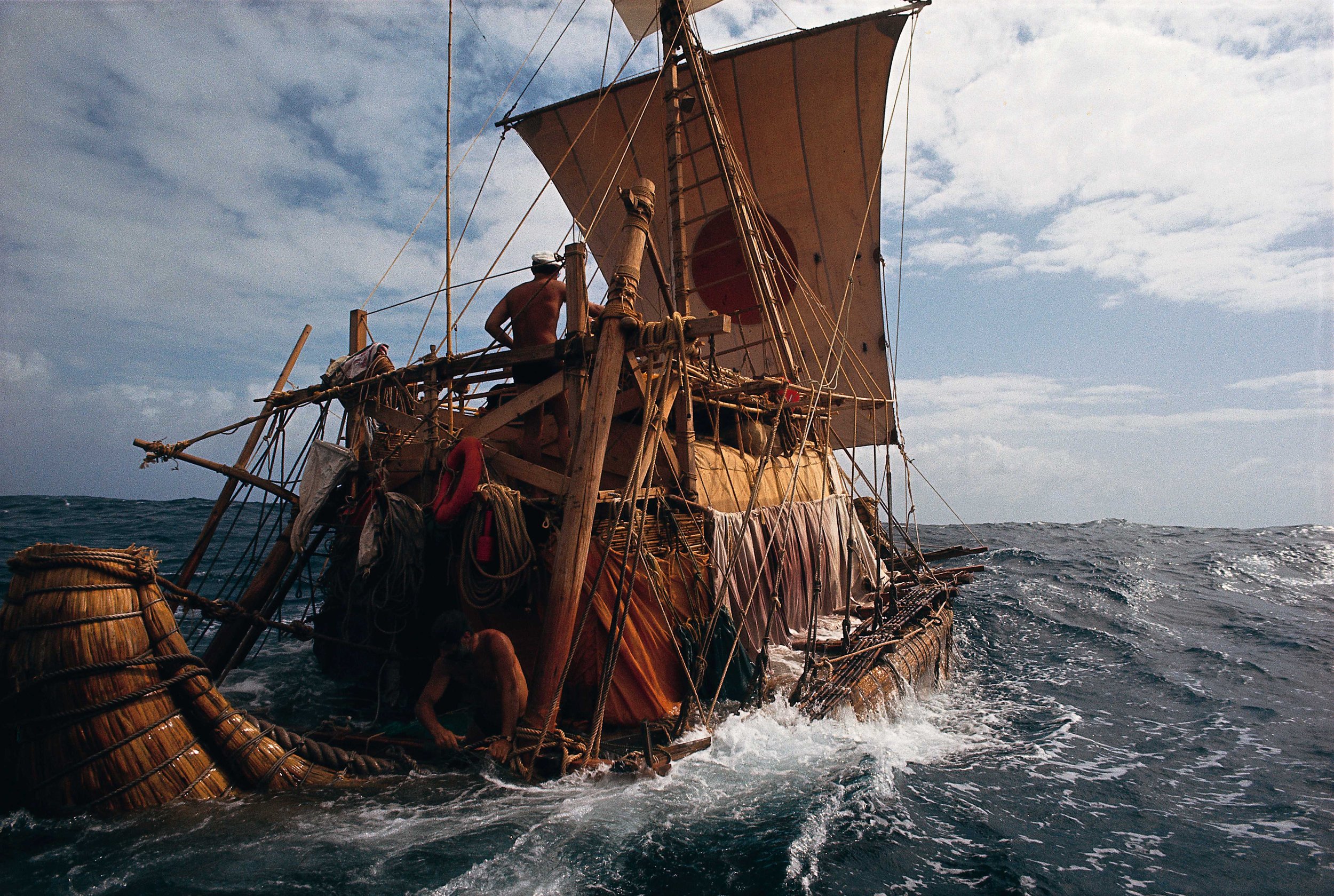
Ra II at sea (Photo: Thor Heyerdahl Archives, The Kon-Tiki Museum).
The two expeditions demonstrated one of the most important strengths of experimental archaeology: failure could produce knowledge. The first vessel revealed structural problems. The second tested the solutions.
In 1977, Heyerdahl launched the reed ship Tigris from Iraq. This time he was examining possible maritime connections among Mesopotamia, the Indus region, and the civilizations around the Red Sea. The voyage ended in Djibouti in 1978, when regional warfare prevented the crew from continuing. Heyerdahl burned the vessel in protest against the conflicts and the international trade in weapons that sustained them.
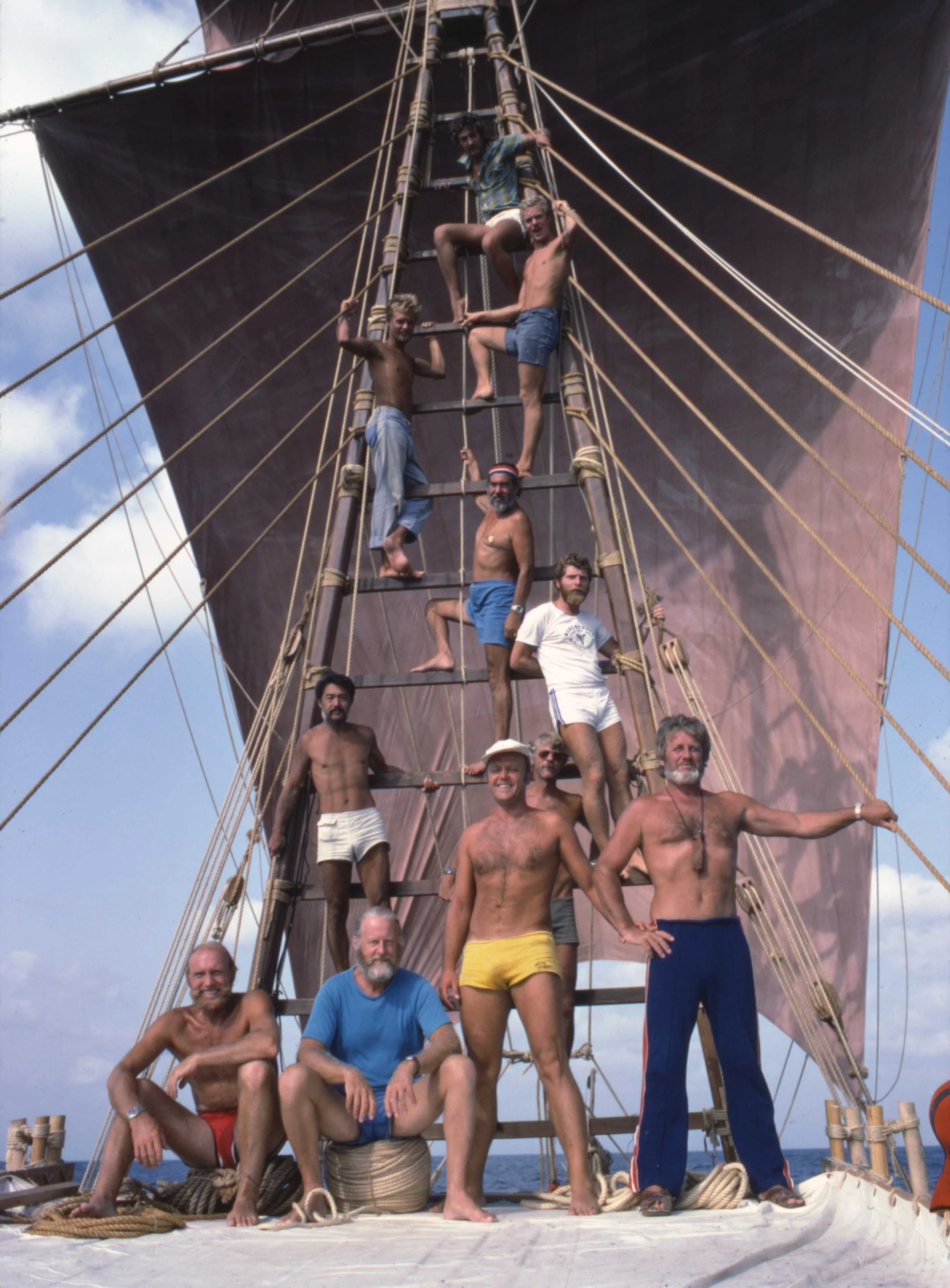
The crew on Tigris. First row, from left: Norman Baker (USA), Yuri Senkevitch (Sovjet Union) and Carlo Mauri (Italy). Second row: Toru Suzuki (Japan), Norris Brock (USA) and Detlef Soitzek (Germany). Third row: Carrasco Gherman (Mexico). Fourth row: Asbjørn Damhus (Denmark). Fifth row: Hans Petter Bøhn (Norge). On top: Rashad Nazir Salim (Irac).
By then, his experimental method had expanded far beyond the original question of Polynesia. A primitive-looking vessel could investigate technology, navigation, contact between civilizations, and the political condition of the modern world.
Learning Not Merely to Drift, but to Sail
By the late 1980s and 1990s, a new generation of explorers began asking narrower and often more technical questions.
Kitín Muñoz, who called himself a spiritual son of Heyerdahl, sailed the totora-reed vessel Uru from Peru to the Marquesas in 1988. Later, his enormous Mata Rangi vessels tested the limits of reed-ship size and construction. Their difficulties suggested that making a prehistoric-style vessel larger and more impressive did not necessarily make it more seaworthy.
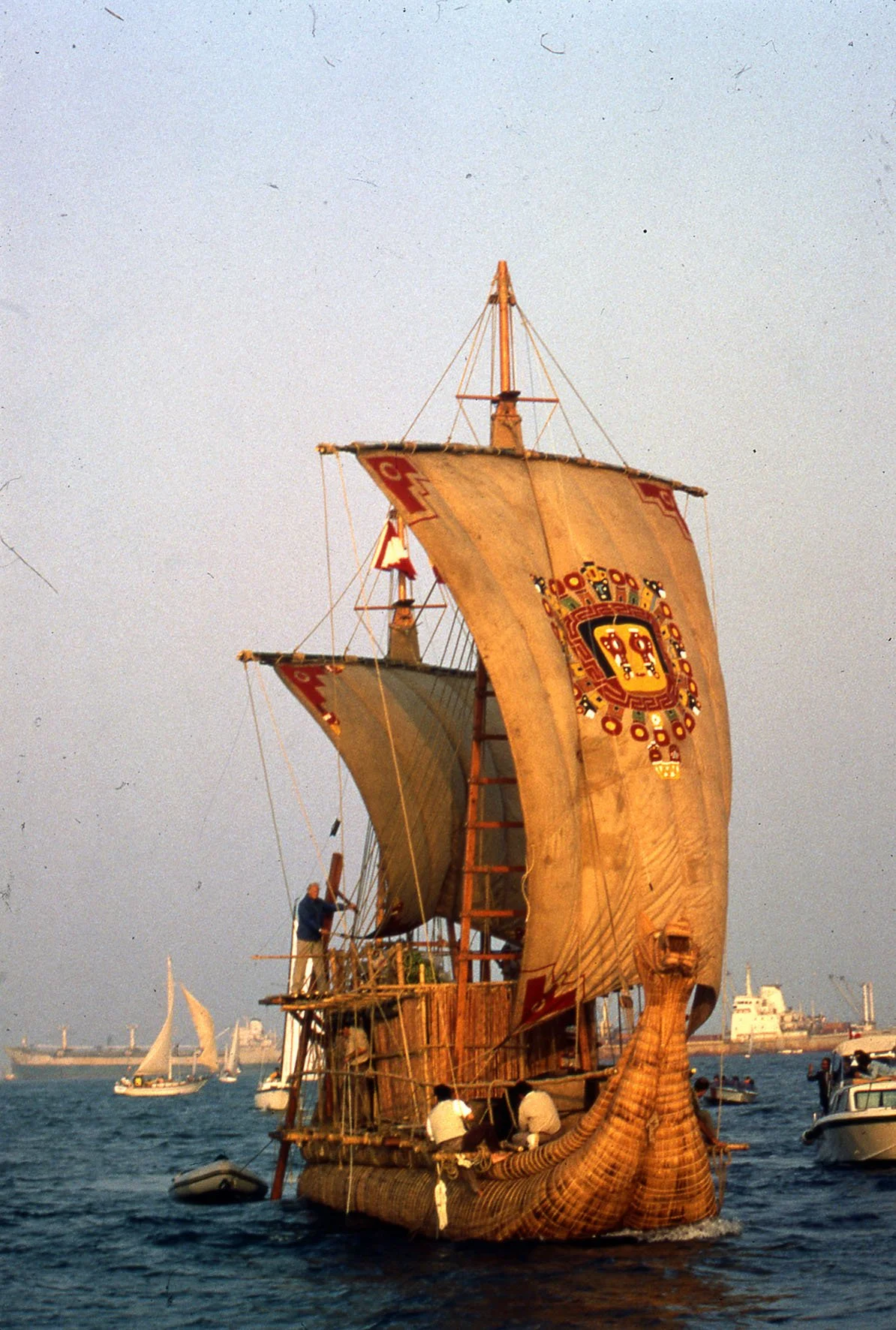
Uru under sail, with Thor Heyerdahl steering (Photo: The Thor Heyerdahl Archives, The Kon-Tiki Museum).
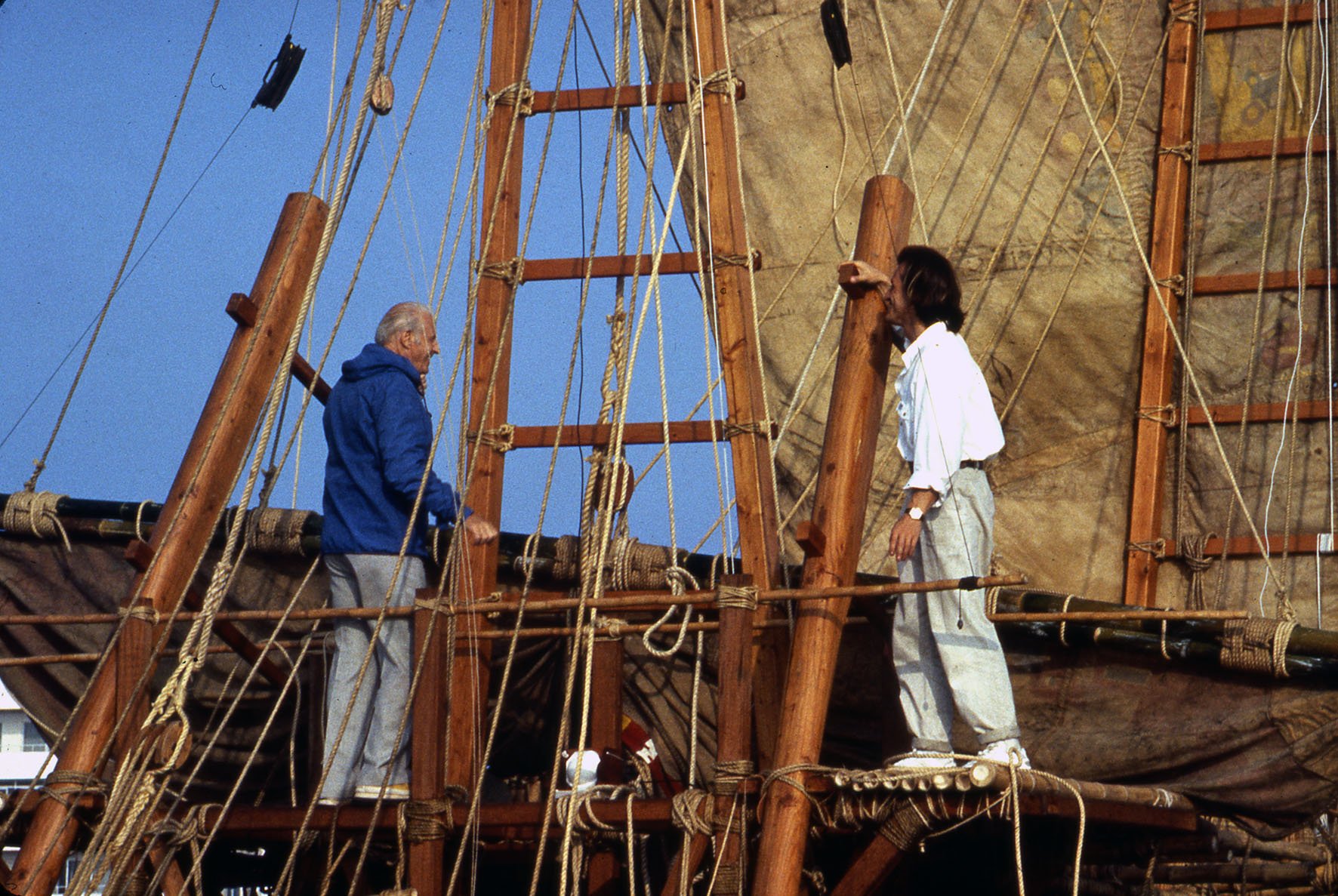
Thor Heyerdahl and Kitin Muñoz aboard the Uru (Photo: The Thor Heyerdahl Archives, The Kon-Tiki Museum).
Tim Severin’s bamboo raft Hsu Fu set out from Asia in 1993 to test whether Chinese mariners might have reached North America. The raft did not complete the crossing, but Severin documented how bamboo, lashings, marine organisms, weather, and human fatigue affected the vessel over months at sea. The experiment’s value lay as much in the recorded deterioration as in the distance covered.
John Haslett initially wanted to copy the great Kon-Tiki adventure. His 1995 raft Illa-Tiki sailed from Ecuador to Panama, where he discovered that wood-boring shipworms had severely damaged the balsa. The failure changed the direction of his work. Instead of merely repeating a celebrated voyage, Haslett began investigating more precise questions about coastal trading routes, balsa harvesting, wood treatment, and the guara centerboards used to steer South American rafts.
That movement—from heroic repetition toward more carefully defined experiments—reached an important point with the Tangaroa expedition in 2006.
Among its six crew members was Olav Heyerdahl, Thor Heyerdahl’s grandson. The raft was built from balsa obtained near the Ecuadorian forests used for Kon-Tiki and left Callao on April 28, exactly fifty-nine years after his grandfather’s departure. It reached Polynesia after 70 days, completing approximately 8,500 kilometers 31 days faster than Kon-Tiki had covered its route.
But speed was not the expedition’s most important achievement.
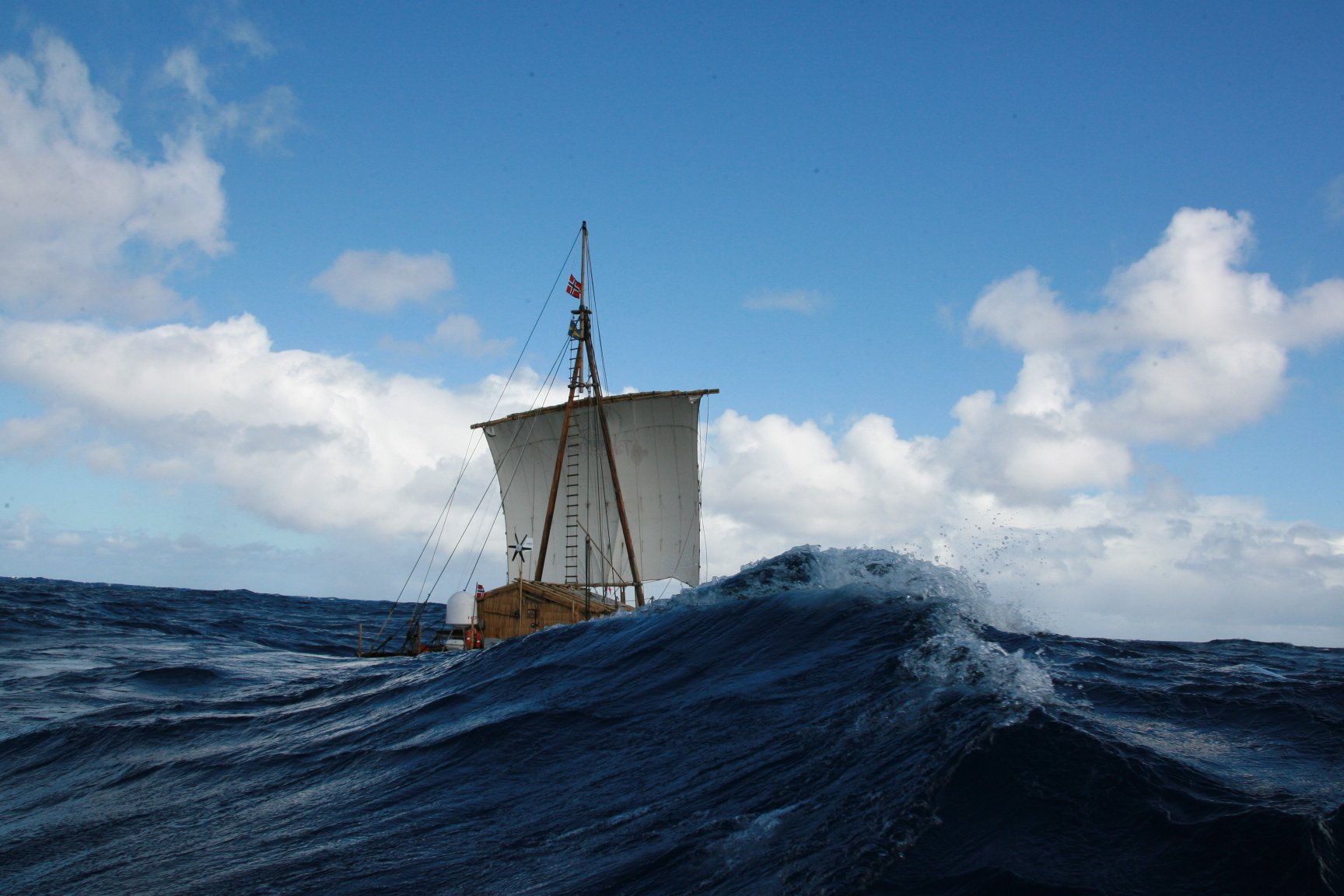
Tangaroa under sail (Photo: Anders Berg/Tangaroa).
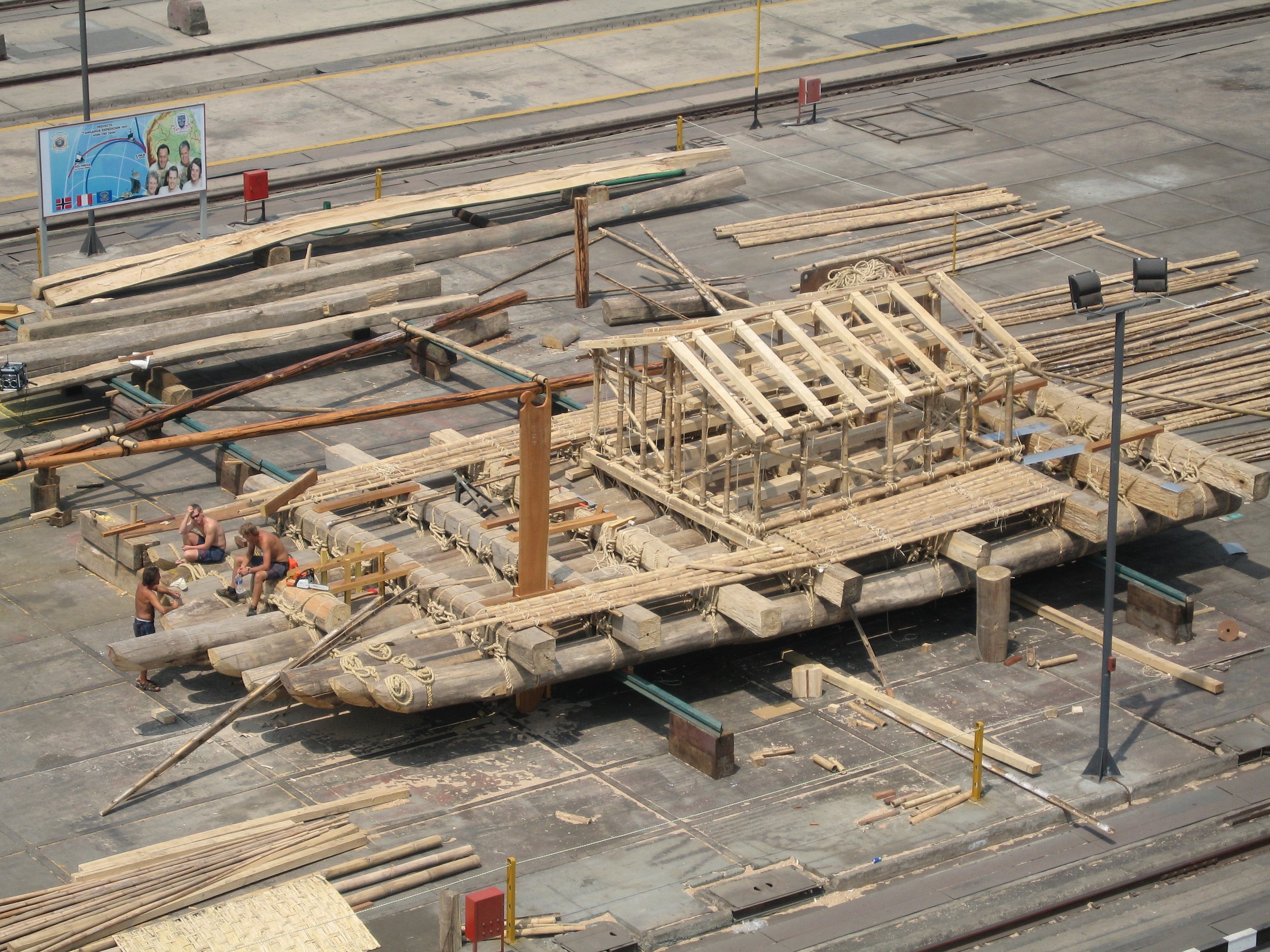
The eleven-log raft under construction in Callao, Peru (Photo: Anders Berg/Tangaroa).
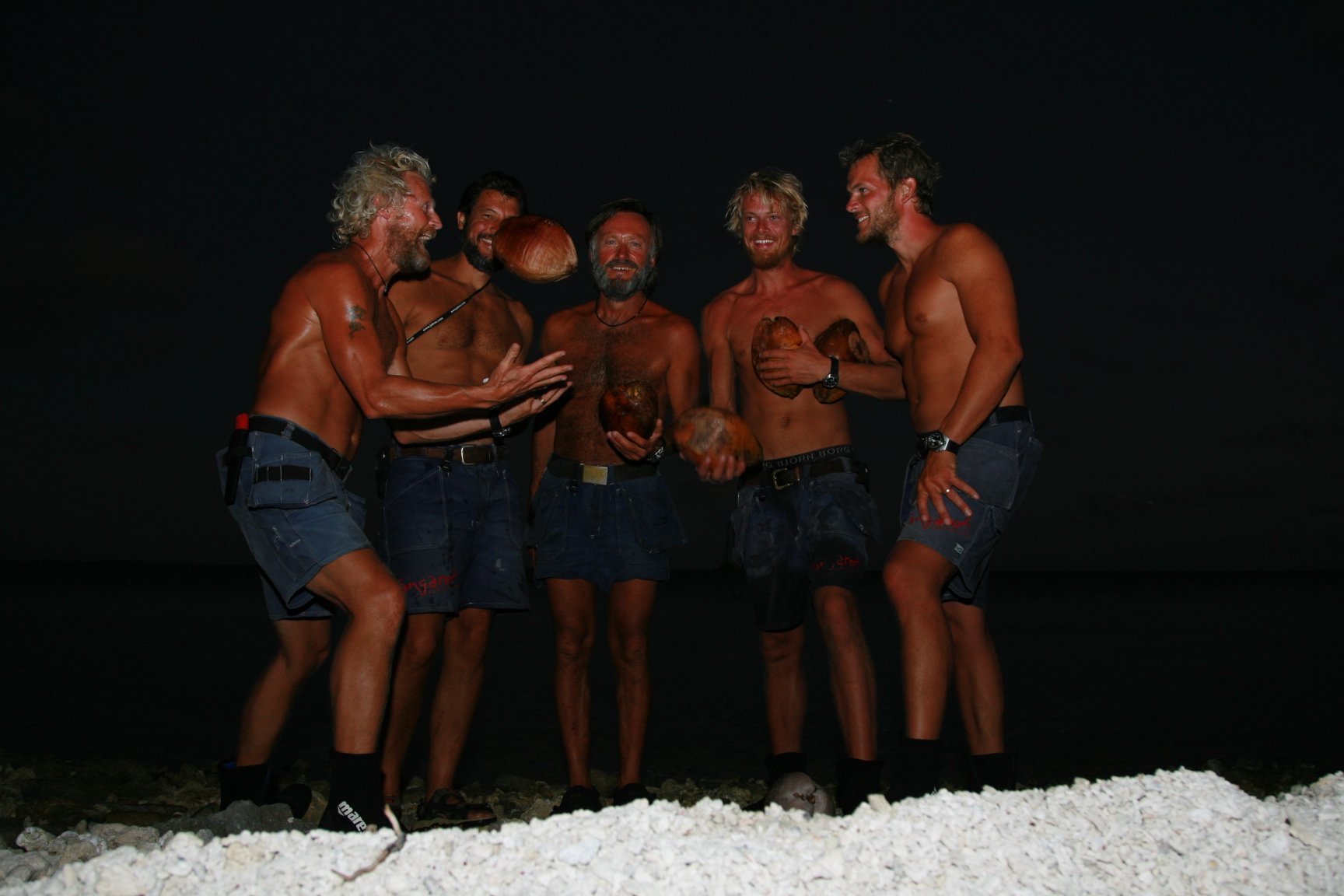
The expedition has reached Polynesia, from left: Anders Berg, Roberto Sala, Øyvin Lauten, Olav Heyerdahl, and Torgeir Sæverud Higraff. The captain, Bjarne Krekvik is probably taking the photo (Photo: Anders Berg/Tangaroa).
When Thor Heyerdahl crossed the Pacific in 1947, the crew did not yet fully understand how the removable guara boards of Indigenous South American rafts had been used. On Kon-Tiki, the boards were essentially fixed in position, leaving the raft largely at the mercy of wind and current.
Tangaroa carried nine adjustable guaras. By raising and lowering different boards, the crew learned to alter the raft’s resistance in the water. Working with the sail, the guaras allowed them to change direction and steer effectively without a conventional rudder. The raft was not simply drifting wherever the current took it. It could be sailed.
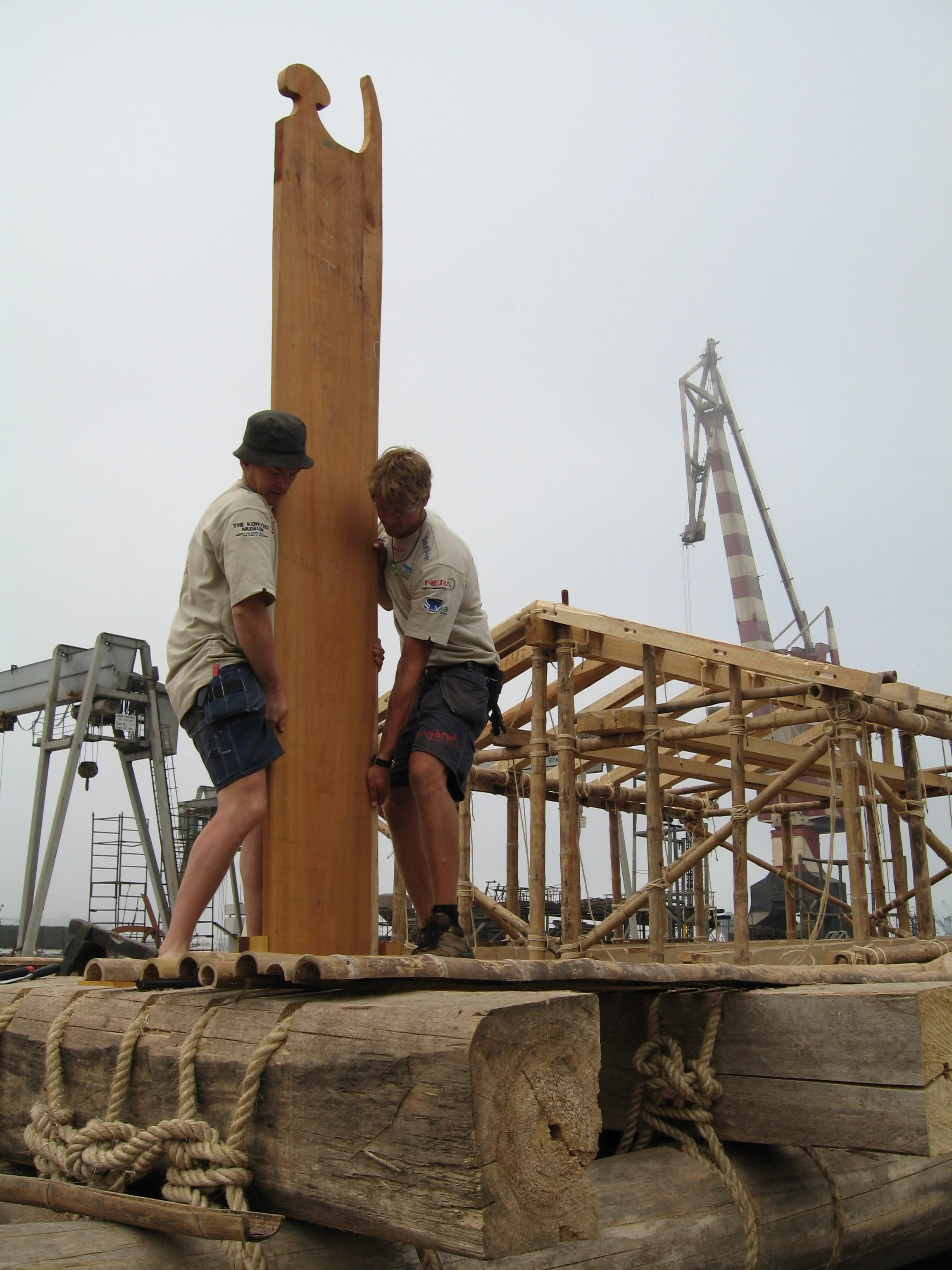
One of the nine giant guara boards are fitted into place (Photo: Anders Berg/Tangaroa).
That discovery refined the meaning of the original voyage.
Kon-Tiki had shown that a balsa raft could survive the Pacific. In 2006, Thor Heyerdahl’s grandson and others set out from Peru in Tangaroa to recreate the Kon-Tiki Expedition. They greatest accomplishment was to learn how to sail a balsa-wood log-raft only using the indigenous Peruvian steering technique of guara boards. What had appeared to modern observers as a primitive floating platform was, in practiced hands, a sophisticated sailing craft. Where Heyerdahl had used 101 days to cross from Callao, Peru, to Raroia in French Polynesia, Tangaroa did it in just two months.
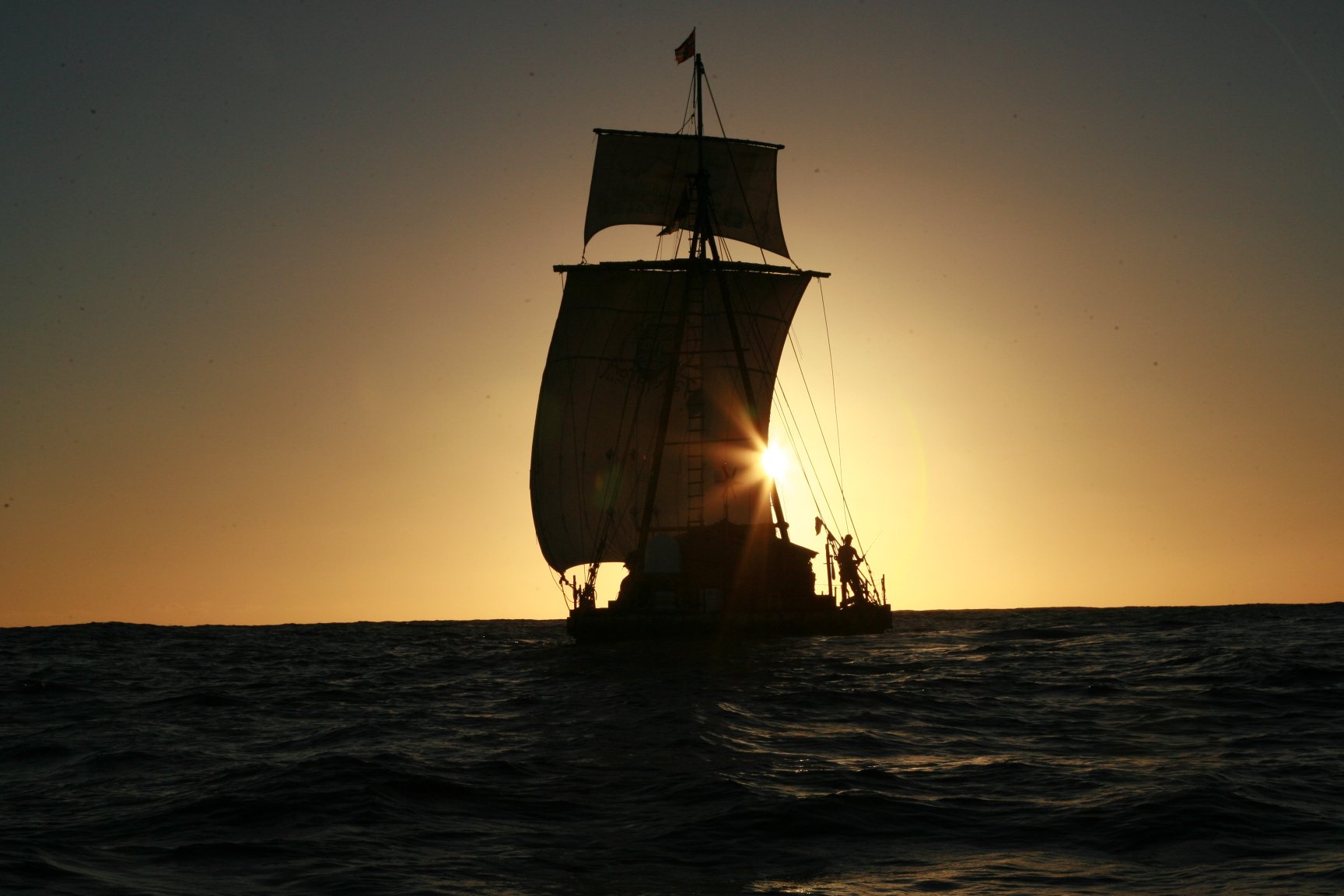
Sailing into Polynesia (Photo: Anders Berg/Tangaroa).
Olav Heyerdahl had not merely repeated his grandfather’s journey. He and the crew had answered a question that Kon-Tiki had left open.
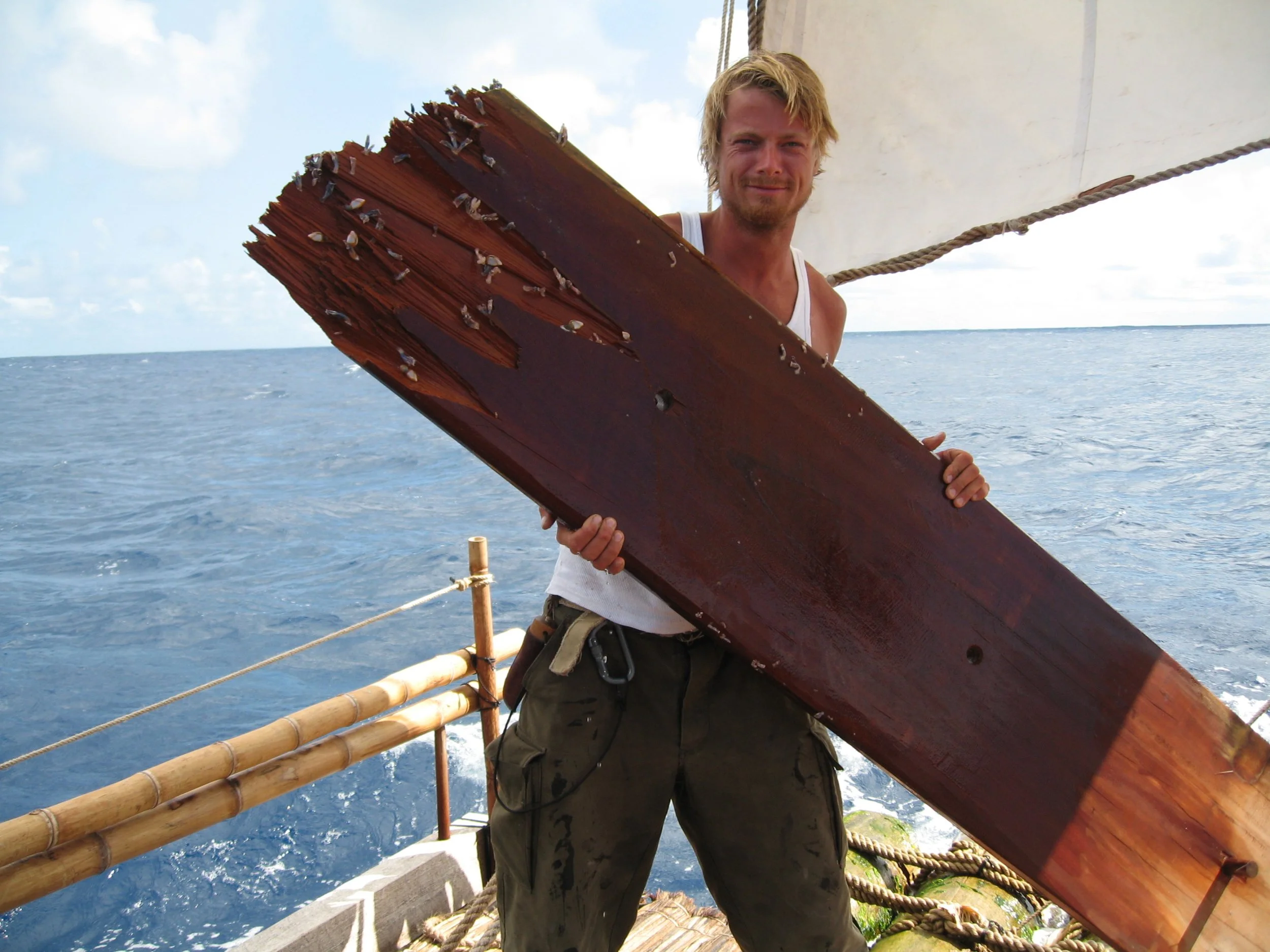
Olav Heyerdahl with one of the guara boards (Photo: Anders Berg).
The Voyage as an Argument
The expeditions inspired by Thor Heyerdahl did not collectively prove his theories about the settlement of Polynesia or contact between ancient civilizations.
Some were carefully designed experiments. Others mixed serious questions with personal ambition, ideology, spectacle, or pseudoscience. A few demonstrated little beyond the astonishing things human beings will attempt once they have built a raft and attracted a sponsor.
Yet even the failures produced observations. Rafts became waterlogged. Reeds broke. Bamboo lashings wore through. Shipworms ate balsa from the inside. Winds carried vessels away from their planned destinations, while currents trapped others within sight of routes they could not reach.
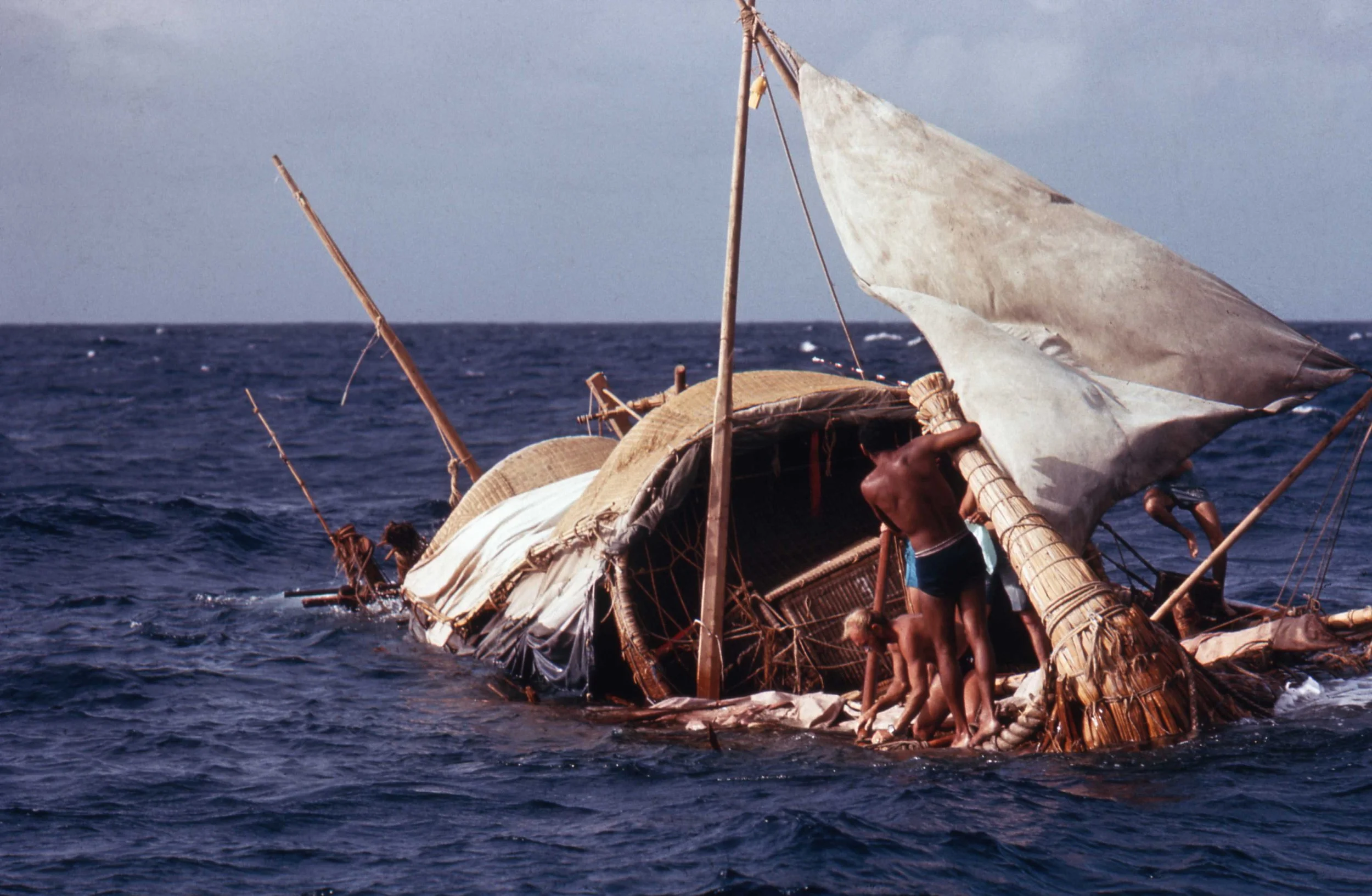
Ra, 1969. The boat fell apart and had to be abandoned one to two weeks from Barbados (Photo: Thor Heyerdahl Archives, The Kon-Tiki Museum).
The ocean refused to behave like a diagram.
That was precisely why the voyages mattered.
Heyerdahl’s most durable legacy may not be an answer about who first crossed a particular ocean. It may be the permission he gave others to ask historical questions with ropes, logs, reeds, sails, guara boards—and their own bodies.
Kon-Tiki did not settle the debate over Polynesia.
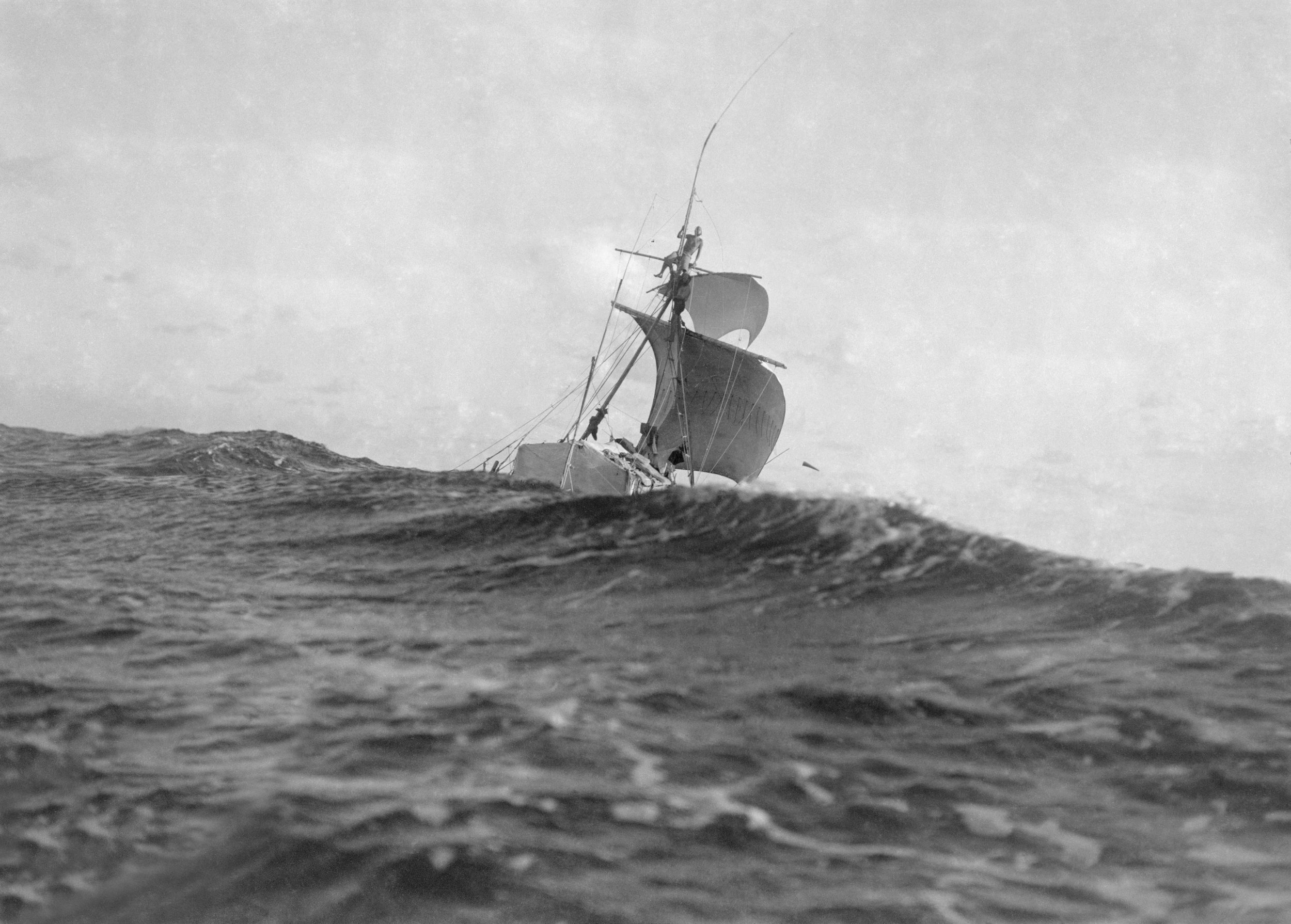
Kon-Tiki crossing the Pacific in 1947 (Photo: Thor Heyerdahl Archives, The Kon-Tiki Museum).
It changed the way the debate could be explored.