

From the Museum Archive to a Doctorate
On a warm Friday in early June, I walked slowly uphill along the gravel paths of Lund University. The sun was bright, but a light breeze kept the heat from becoming oppressive.
My destination was less picturesque: lecture room B:152 in the modern LUX building. At 1:15 p.m., the room was to become the setting for one of academia’s oldest rituals—the public defence of a doctoral dissertation.
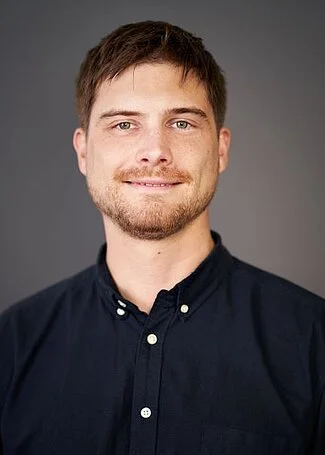
Anton Öhman, Ph.D.
The candidate was Anton Öhman.
The Beginning of a Research Journey
I first met Anton almost ten years earlier, when he received a grant to help the Kon-Tiki Museum organize the documentary archive of Bengt Emmerik Danielsson.
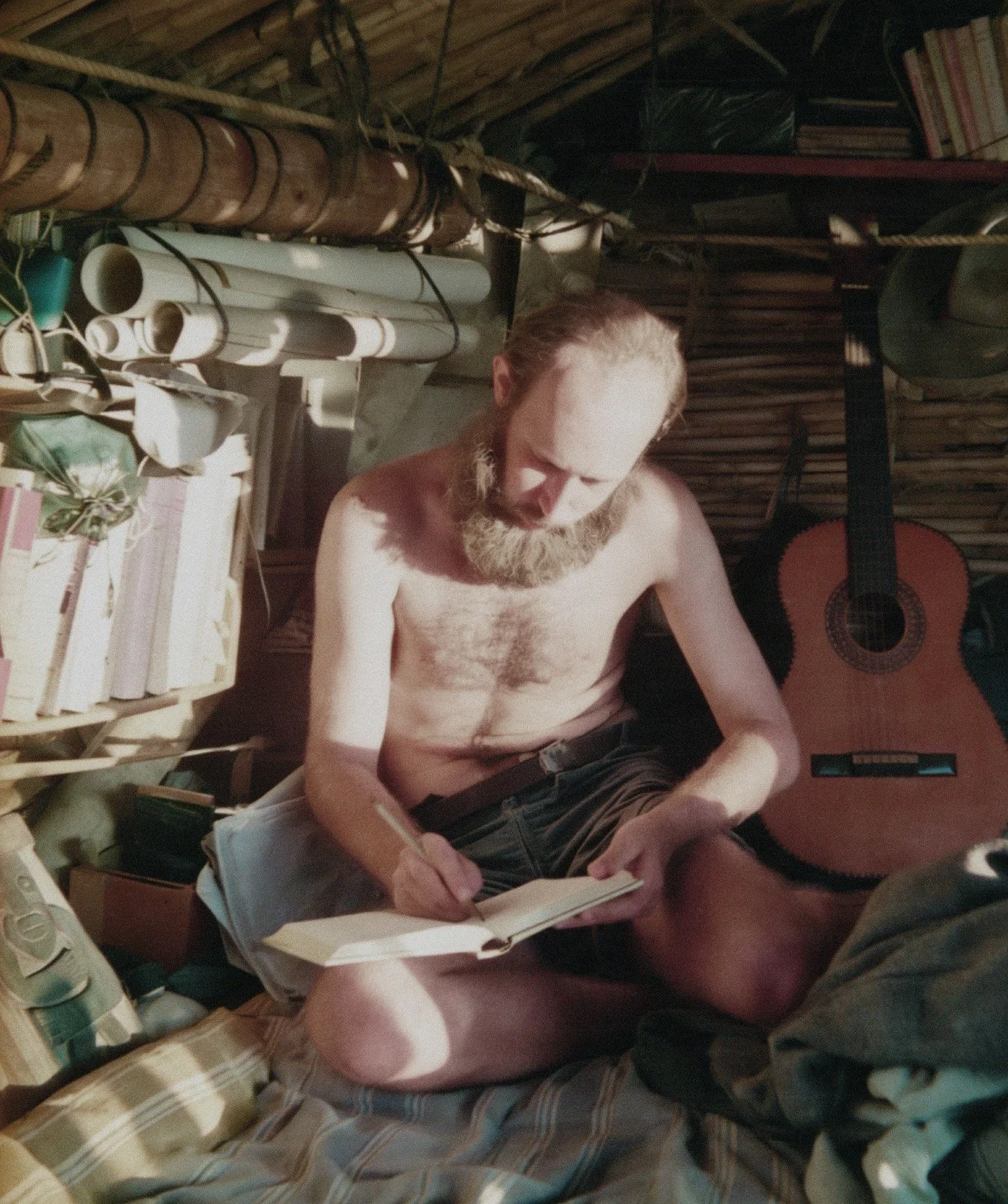
Bengt Emmerik Danielsson on the Kon-Tiki raft, 1947.
Danielsson is best known internationally as one of the six men who crossed the Pacific aboard the Kon-Tiki raft in 1947. But his later campaign against French nuclear testing in Polynesia may be an equally important part of his legacy.
After settling in Tahiti, Bengt and his wife, Marie-Thérèse Danielsson, became outspoken critics of the French nuclear tests at Moruroa and Fangataufa. Their publications included Moruroa, mon amour, first published in 1974, and the expanded English-language book Poisoned Reign: French Nuclear Colonialism in the Pacific, published in 1986.
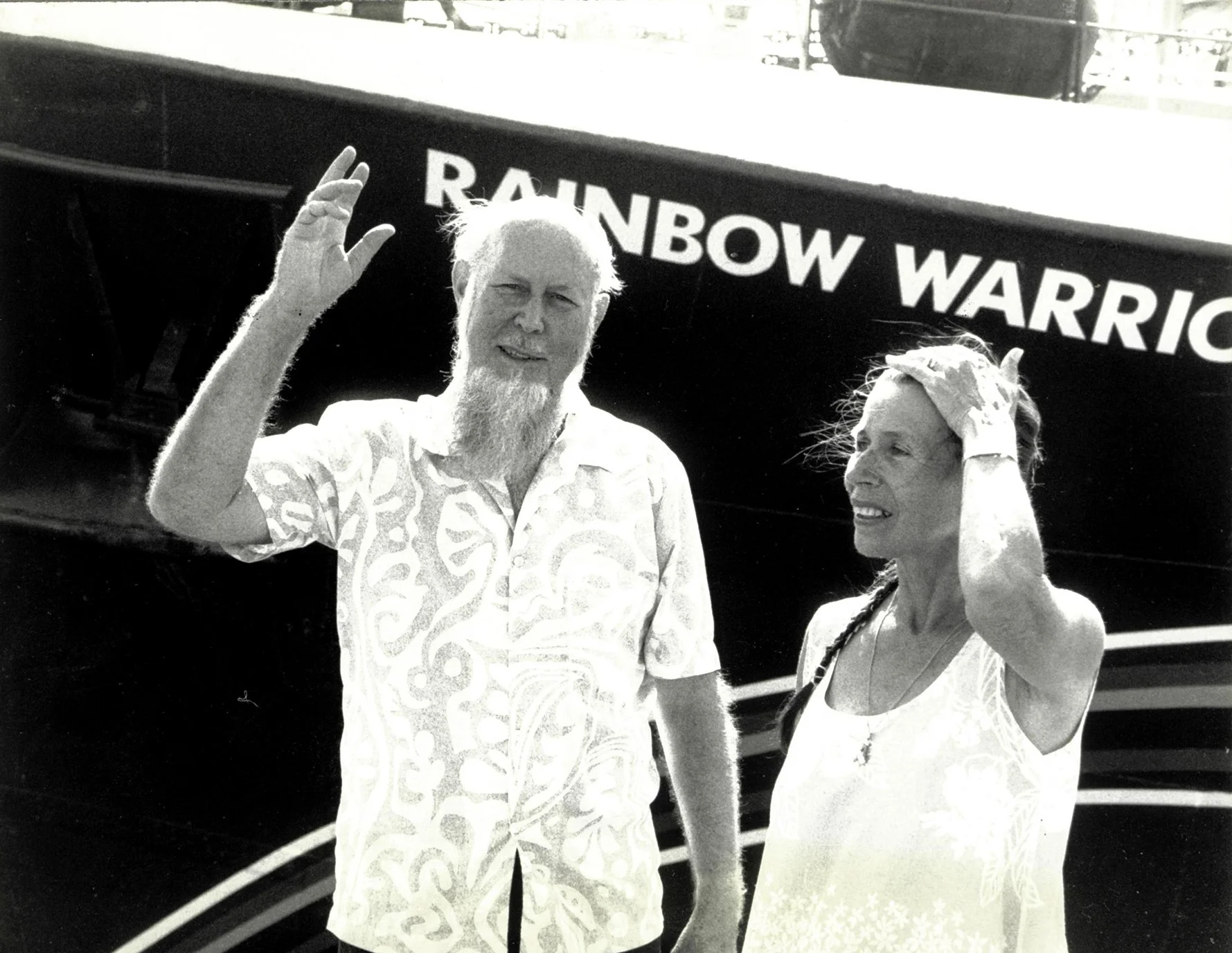
Bengt Danielsson and Marie-Thérèse in front of the Greenpeace ship Rainbow Warrior, before it was sunk by French agents.
The Danielssons collected letters, reports, newspaper articles, photographs, testimonies, and political documents. Together, these materials formed an extensive archive of Pacific history, colonialism, and anti-nuclear activism.
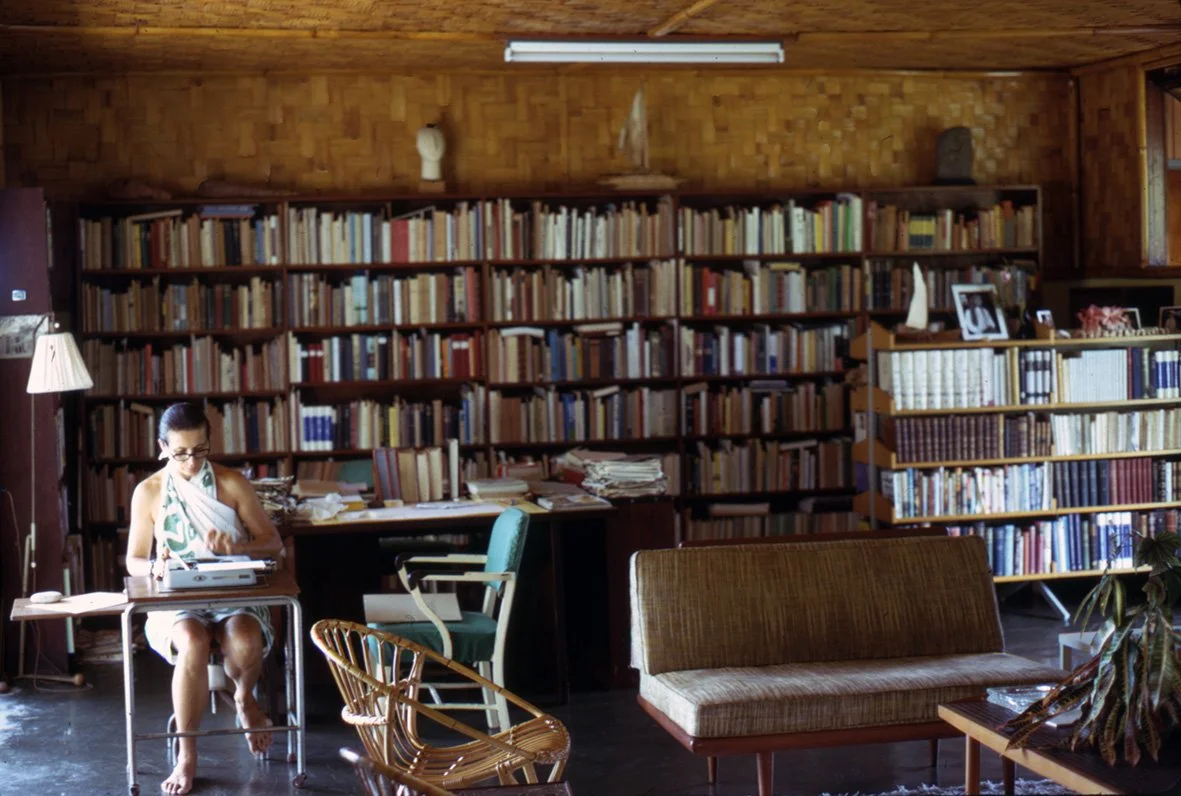
Marie-Thérèse Danielsson working in the couple’s library and archive next to their house in Tahiti.
Anton helped bring order to this collection.
In 2017, the work resulted in a preliminary catalogue:
Bengt Danielsson Archive: Preliminary Catalogue, August 2017.
The Kon-Tiki Museum Field and Archive Report Series, vol. 14.
O. E. Johannes Stenberg, Anton Olof Öhman, and Reidar Solsvik.
The following year, Anton completed his master’s thesis at Lund University:
Vittnesarkivet: En ekofenomenologisk kartläggning av ett nukleärt kulturarv gällande atombombsprovsprängningarna i Franska Polynesien (Öhman 2018).
The title may be translated as:
The Testimony Archive: An Ecophenomenological Mapping of the Nuclear Heritage of Nuclear Weapons Testing in French Polynesia (Öhman 2018).
The archive had become more than a collection of historical papers. It had become the starting point for a much larger research project.
An Old Academic Tradition
Nearly a decade later, I had come to Lund to see where that project had led.
Lund University was founded in 1666 and formally inaugurated two years later. It is one of Sweden’s oldest universities, although not the country’s first—that distinction belongs to Uppsala University.
Academic degree ceremonies have been held in Lund since 1670. The first ceremony was a promotion of masters, while the university’s first promotion of Doctors of Theology took place in 1672.
Anton was therefore following a path taken by generations of scholars before him. But the subject of his dissertation was firmly rooted in the modern world.
Its title was:
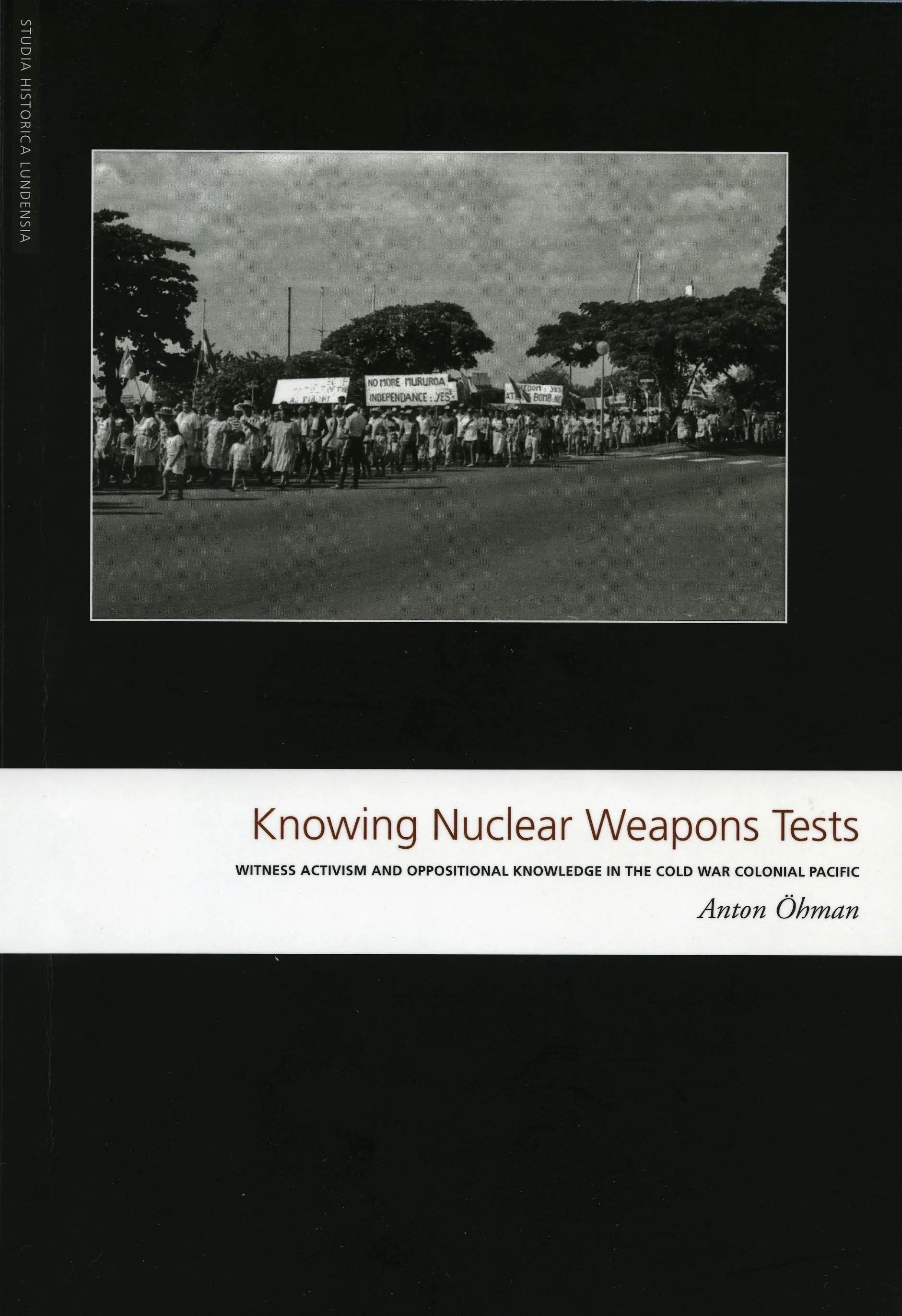
Knowing Nuclear Weapons Tests: Witness Activism and Oppositional Knowledge in the Cold War Colonial Pacific.
The dissertation runs to 374 pages and examines how knowledge about nuclear weapons testing was produced, challenged, and made credible from the 1950s to the early 2000s. Its main focus is French Polynesia and the activists who worked to expose the human and environmental consequences of the tests.
The Public Defence
A public PhD defence is not simply a presentation of completed research. The candidate must explain and defend the dissertation’s arguments, methods, sources, and conclusions.
Anton’s faculty opponent was Professor Casper Andersen of Aarhus University. For around two hours, they discussed the dissertation and the difficult questions at its centre: How is knowledge about nuclear testing created? What counts as reliable evidence? And who has the authority to speak about radiation, illness, colonialism, and harm?
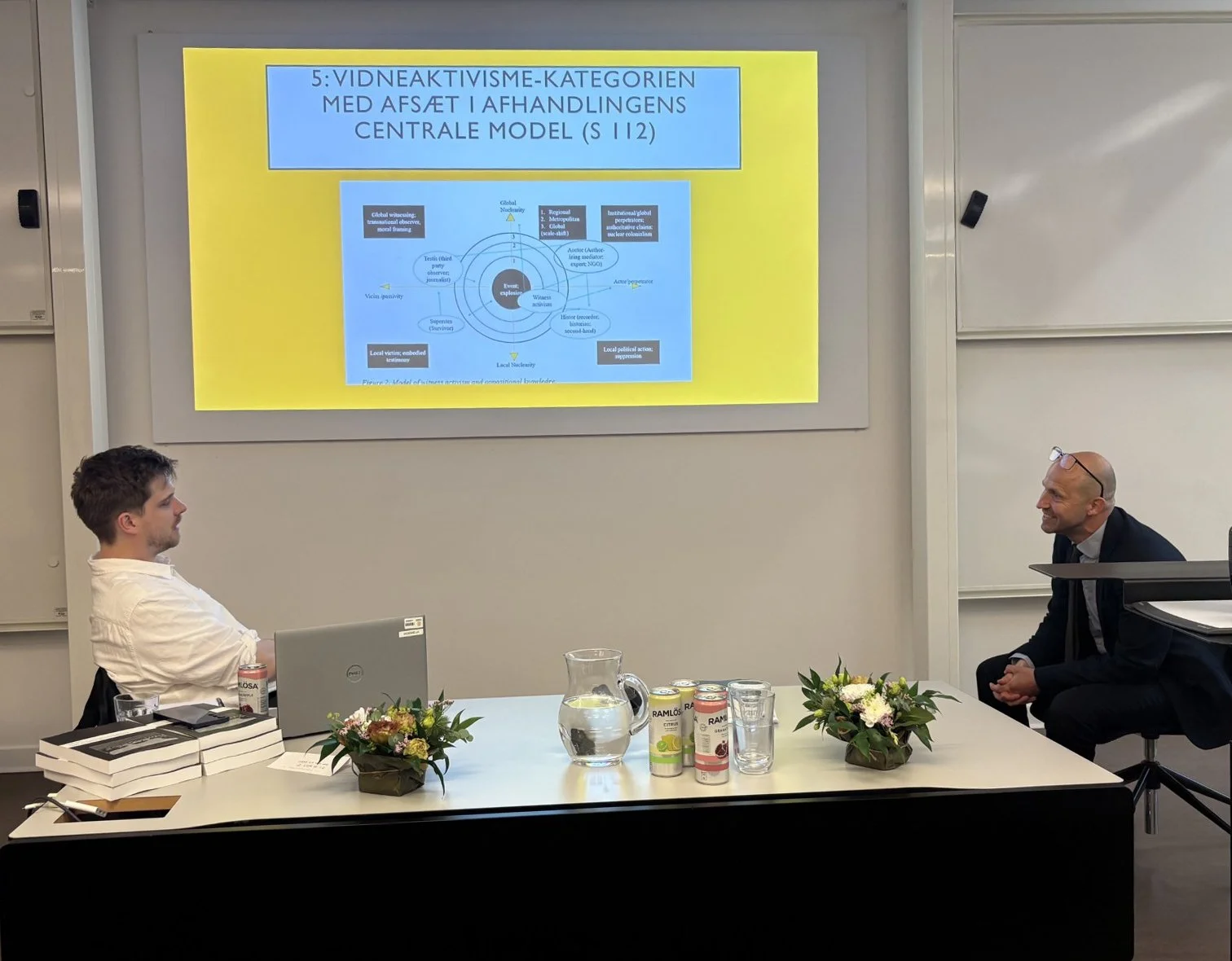
The doctoral candidate Anton Öhman and the opponent, Professor Casper Andersen.
Then the examining committee withdrew to consider its decision.
We waited.
At least one person in the room was biting his nails.
Eventually, the committee returned and announced that the dissertation had been approved. Anton Öhman had successfully defended his PhD in History.
The work that had begun years earlier among the boxes and documents of the Bengt Danielsson Archive had become something much larger. It was now a study of how Pacific activists challenged secrecy, scientific authority, and some of the world’s most powerful institutions.
To understand what was at stake in that defence, we must turn to the story Anton tells in his dissertation.
How Pacific Activists Challenged the Nuclear Powers
For decades, governments presented nuclear weapons testing in the Pacific as controlled, scientific, and safe. Much of the information about the tests remained secret, while official reports often played down their effects on people and the environment.
But activists across the Pacific began building a different story.
This dissertation examines how they gathered, produced, and shared knowledge about nuclear testing from the 1950s to the early 2000s. The main focus is French Polynesia, but the story stretches far beyond the islands. Documents, testimonies, scientific reports, and political arguments travelled between the Pacific, France, and international anti-nuclear networks.
At the heart of this story is what I call witness activism.
Witness activism was about more than telling personal stories. Activists interviewed people affected by the tests, searched for missing or secret documents, added explanations and comments to official reports, built archives, published their findings, and shared information across borders.
Together, these activities challenged government secrecy and official claims about nuclear safety. They also gave local communities and activists a stronger voice in debates that had long been dominated by governments, military institutions, and scientific experts.
Turning Fragments into Evidence
The dissertation looks closely at activist archives. These were not simply storage rooms filled with old papers. They were places where knowledge was actively created.
Activists brought together letters, newspaper articles, scientific studies, photographs, official reports, personal memories, and leaked or declassified documents. A single document might reveal very little. But when many fragments were collected and compared, they could expose patterns of secrecy, environmental damage, illness, and colonial inequality.
In this way, the archives helped activists fight against organised ignorance. Governments did not always need to prove that nuclear testing was harmless. Sometimes it was enough to create doubt, withhold information, question witnesses, or claim that the scientific evidence was uncertain.
Activists responded by preserving what might otherwise have disappeared. They connected documents with personal experiences and used both to build alternative histories of nuclear testing in the Pacific.
Two Important Networks
The dissertation follows two particularly important centers of this work.
The first is the collection created by Bengt and Marie-Thérèse Danielsson. The second is the French anti-nuclear network OBSARM, the Observatoire des armaments.
Both helped bring knowledge from French Polynesia into wider French and international debates. They translated local experiences into reports, books, campaigns, and political arguments that could reach journalists, researchers, lawyers, and decision-makers.
Their work questioned official safety claims and challenged the scientific methods used to measure the health effects of nuclear testing. It also became part of wider campaigns for recognition, compensation, disarmament, and justice.
From Documents to Personal Stories
One of the dissertation’s main arguments is that activist archives were never finished. They continued to grow as new documents appeared, witnesses came forward, and political conditions changed.
A second argument is that activists created their own authority. They did not rely on one type of evidence alone. Instead, they combined official documents, scientific studies, political analysis, and lived experience.
A third argument concerns how activism changed over time.
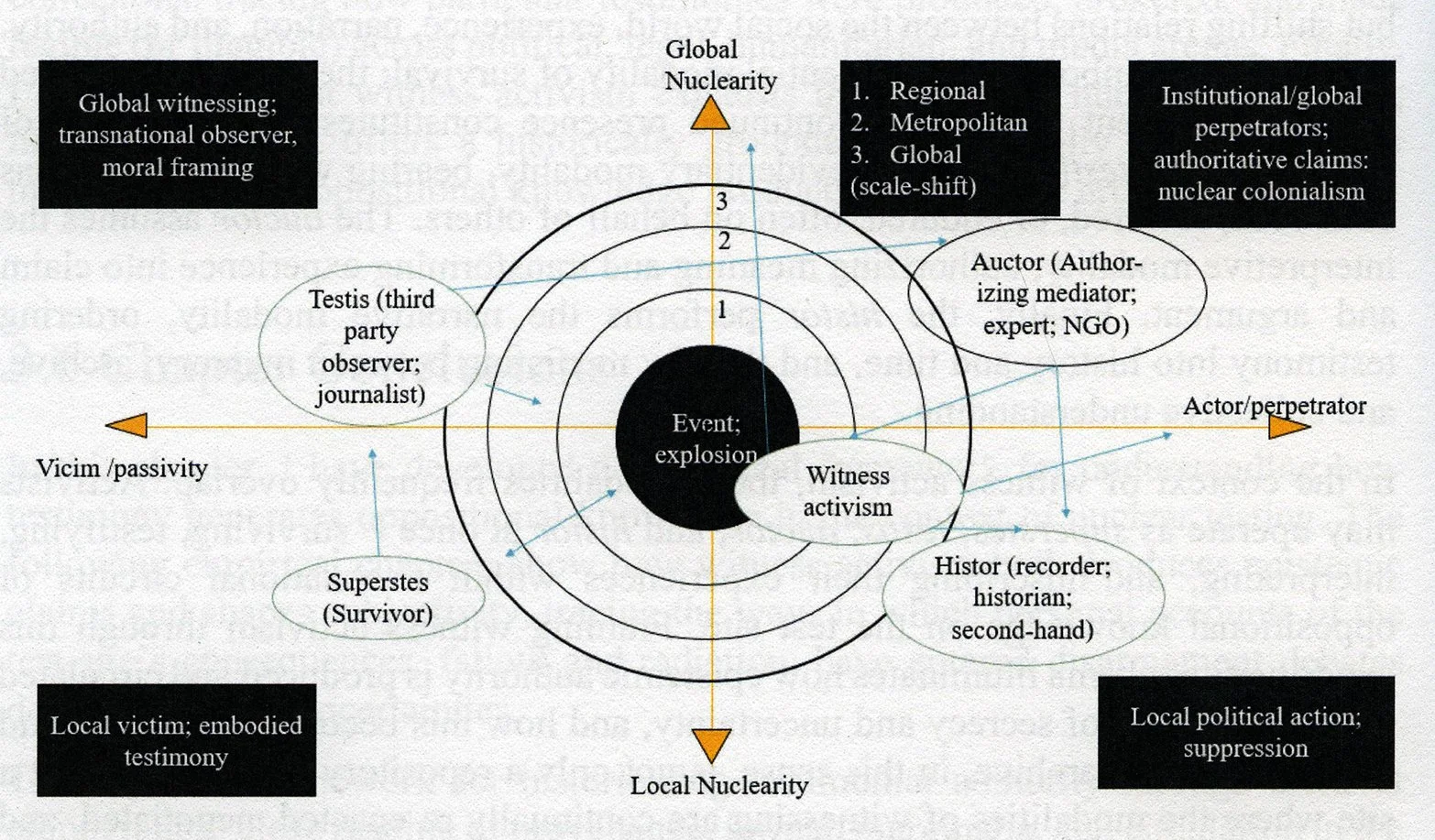
Anton Öhmans main arguments distilled in one figure (Öhman 2026, page 112).
In the early 1970s, anti-nuclear activists often focused on colonialism, military power, government secrecy, and official documents. By the 1980s and 1990s, personal testimony had become increasingly important.
People spoke publicly about illness, radiation exposure, fear, displacement, and loss. Their stories brought the human consequences of nuclear testing into view and gave the issue a new emotional and political force.
Why Testimony Mattered
The growing importance of personal testimony was part of a wider change in public life. During the late twentieth century, the voices of victims and witnesses gained greater importance in humanitarian, legal, and political debates.
But testimony did not suddenly appear in the 1990s. It had deeper roots.
The people who spoke about their experiences were part of longer traditions of anti-colonial struggle, political protest, scientific criticism, and documentary work. Their testimony was powerful partly because it was supported by archives, reports, photographs, and years of activist research.
The shift towards testimony therefore did not mean that documents and science became less important. Instead, personal stories became a new way of connecting evidence with questions of responsibility and justice.
Who had been harmed? Who had known about the risks? Who should be held responsible? And whose knowledge should be believed?
These questions were central to Pacific anti-nuclear activism.
By following the people who collected documents, recorded testimonies, built archives, and carried information across borders, this dissertation shows how communities with limited political power challenged some of the world’s most powerful institutions.
It is a story about nuclear weapons, but it is also a story about knowledge: who controls it, who is excluded from it, and how people can use it to fight secrecy, colonialism, and injustice.
If you find this interesting, you can download and read Anton Öhman’s dissertation here.
An official Ph.D. Anton Öhman and Reidar Solsvik, just after the official promotion.